
Executive Summary & Key Takeaways
Key Insights- Treat routing as a measurable systems problem, not only a model-selection problem.\n• Establish a baseline before claiming latency or cost improvements.\n• Use narrow agent permissions, timeouts, fallbacks, and human escalation.\n• Track routing quality, p95/p99 latency, reliability, and cost per resolved interaction.
Quick Definition / Direct Answer
Direct SummaryA production multi-agent customer-routing system combines a policy-aware router, specialized agents, model-serving infrastructure, controlled tools, and observability. Performance and cost improvements must be demonstrated with a defined baseline and comparable measurements rather than assumed from the use of fine-tuned models or multi-agent orchestration.
Real-time customer routing with multiple AI agents is a systems problem: the routing layer must choose the right capability quickly, enforce policy boundaries, and degrade safely when a model or downstream service is unavailable. Model choice alone does not establish production performance.
What Does a Production Routing System Need to Do?
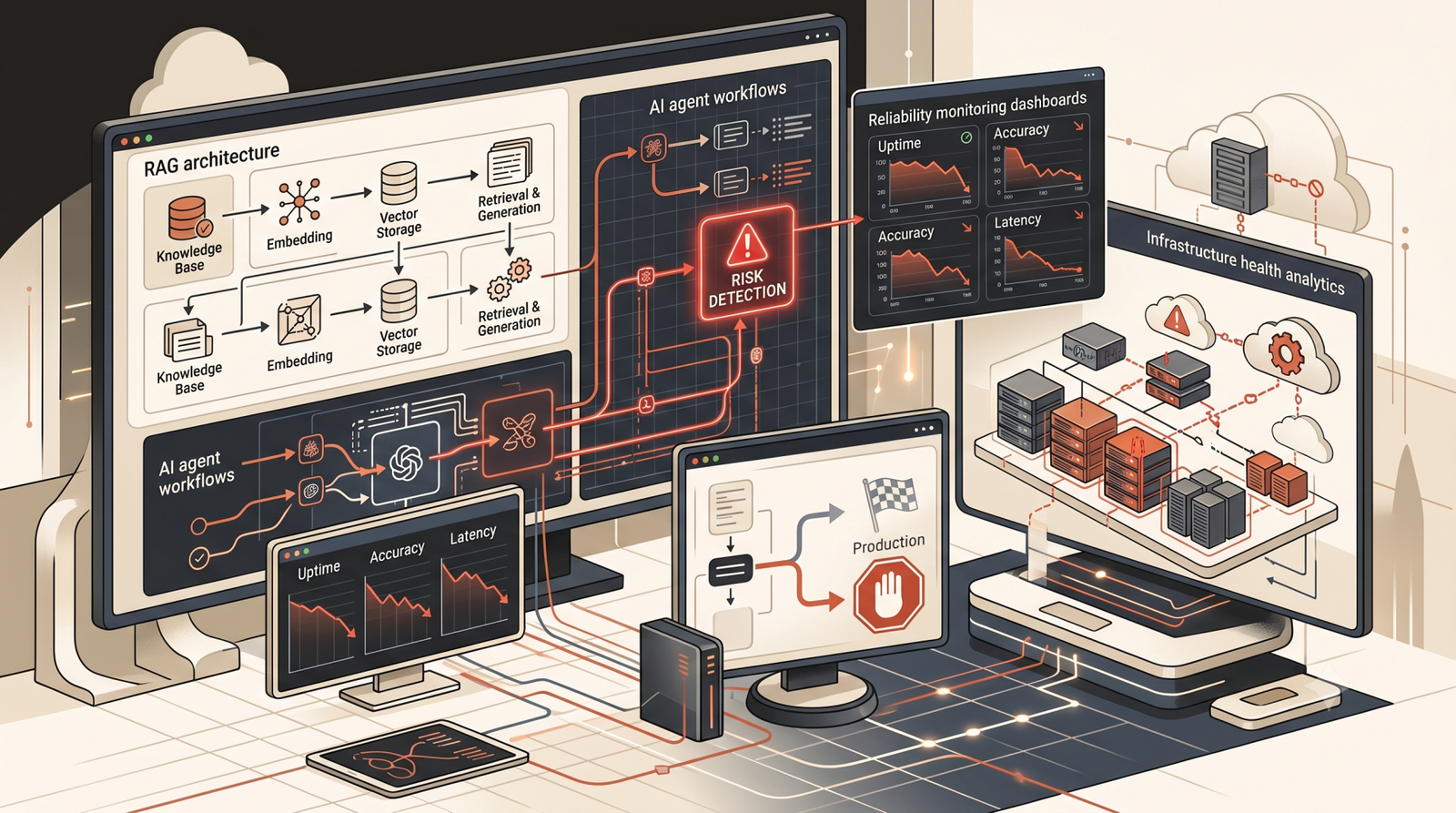
A routing system receives a customer request, classifies intent and risk, selects an eligible agent or workflow, executes approved tools or models, and returns a response. The architecture should make these decisions observable and enforce authorization before sensitive actions are performed.
Reference Architecture
- API gateway: Authentication, rate limits, request validation, tenant context, and request IDs.
- Router: Intent classification, policy checks, confidence thresholds, and agent selection.
- Specialized agents: Narrowly scoped capabilities rather than unrestricted general-purpose agents.
- Model serving: Independently scalable inference endpoints with explicit timeout budgets.
- Tool layer: Allowlisted business actions with authorization and audit logging.
- Observability: Traces, latency, errors, routing decisions, evaluation outcomes, and cost signals.
A useful request path is gateway → router → policy check → specialized agent → tool or model → response. The router should remain stateless where practical so replicas can scale horizontally. Conversation state and evaluation events should live in dedicated stores rather than inside an individual router process.
Need AI or Software Engineering Support?
Turn your ideas and technical challenges into reliable, scalable solutions with Acadify. From AI development and automation to software engineering and product development, we help businesses build and grow with confidence.
Routing Decisions and Confidence Thresholds
Routing should combine intent, confidence, risk, tenant policy, and service availability. A high-confidence classification is not automatically safe: a payment request, account change, or other sensitive workflow can require stronger authorization and human escalation even when the classifier is certain.
Router Decision Contract
A useful decision object contains an intent label, confidence score, risk score, selected agent, fallback route, and human-escalation flag. Keeping these fields explicit makes routing behavior testable instead of hiding business logic inside prompts. The router can reject unsupported intents, select a fallback when confidence is below a configured threshold, or escalate when risk exceeds policy.
Async Multi-Agent Execution Pattern
For latency-sensitive workloads, the router should avoid unnecessary serial model calls. Independent classification or enrichment tasks can run concurrently, while downstream tool execution remains ordered when one action depends on another. Every remote call should have a timeout and bounded retry policy so one unavailable dependency cannot consume the entire request budget.
A robust execution sequence is: classify the request, validate policy, select the agent, execute within a fixed timeout, validate the result, emit telemetry, and fall back when the primary path cannot complete safely. This separation creates clear testing boundaries for classification, authorization, execution, and recovery.
Model Serving and Fine-Tuned Models
A fine-tuned model can be useful when routing or domain classification depends on organization-specific language, labels, or workflows. The engineering decision should be based on measured quality, latency, throughput, and total cost rather than assuming that a smaller or fine-tuned model will always be cheaper.
Keep the model endpoint behind a stable interface so the router can switch between a fine-tuned model, general model, or deterministic classifier without changing customer-facing routing logic. Version model artifacts, prompts, and evaluation datasets together so routing changes remain reproducible.
Operational Controls
- Timeouts: Set a strict maximum latency budget for every inference and tool call.
- Fallbacks: Provide a lower-cost or safer route when the primary path fails.
- Retries: Retry only transient failures and cap attempts to prevent retry storms.
- Concurrency limits: Protect downstream model servers from traffic spikes.
- Versioning: Record model and router versions with each decision.
- Authorization: Validate permissions before tools can mutate customer or account data.
Observability and Benchmark Design
A routing system needs more than aggregate accuracy. Track routing accuracy by intent, fallback rate, human-escalation rate, p50, p95, and p99 latency, error rate, throughput, inference consumption, and cost per resolved interaction.
Benchmarking should compare the same workload against a defined baseline. Replay a fixed evaluation set across the existing router and the new router, then compare intent accuracy, latency percentiles, fallback frequency, and cost per request. Report sample size, workload mix, model versions, and measurement window so the result can be reproduced.
- Quality: Correct-route percentage and false-route rate by intent.
- Latency: End-to-end p50, p95, and p99 response time.
- Reliability: Timeout, dependency-error, and successful-fallback rates.
- Efficiency: Inference cost and compute utilization per request.
- Business outcome: Resolution rate, escalation rate, and customer workflow completion.
Do not treat an unverified percentage such as a claimed 90% cloud-cost reduction as a benchmark result. A defensible cost claim requires a baseline, comparable traffic, identical accounting boundaries, and a documented measurement period.
Failure Handling and Safety Boundaries
Failures are normal in distributed AI systems. A router should distinguish model timeout, malformed output, policy rejection, unavailable tool, and downstream business failure because each condition can require a different response.
- Model timeout: Switch to a bounded fallback or queue the request.
- Invalid model output: Validate the response schema before execution.
- Policy rejection: Stop the workflow and provide a safe user-facing response.
- Tool failure: Return a recoverable error without repeating irreversible actions automatically.
- High-risk request: Escalate to a human workflow when policy requires it.
Idempotency keys are important for customer operations that create orders, issue refunds, modify subscriptions, or otherwise mutate state. The same request should not execute a business action twice simply because a model or network timeout caused a retry.
Scaling Strategy for Real-Time Routing
Horizontal scaling is easiest when the router is stateless and model-serving capacity can scale independently. Use queueing for workloads that do not require synchronous responses, caching for repeated deterministic lookups, and load shedding when downstream capacity is exhausted.
Capacity planning should start with measured request rate and latency targets. If the system receives R requests per second and each inference worker safely processes W requests per second at the target latency, the baseline worker count is approximately R divided by W, with additional capacity for bursts and failure scenarios. Validate the actual value with load tests rather than relying on a theoretical estimate.
Frequently Asked Questions
What is multi-agent customer routing?
It is an architecture where a routing layer selects among specialized AI agents or workflows according to intent, confidence, policy, availability, and other request attributes.
Does a fine-tuned model guarantee lower cloud costs?
No. Cost depends on model size, utilization, serving infrastructure, request volume, latency requirements, and operational overhead. Savings should be demonstrated against a defined baseline.
What metrics should a routing system monitor?
At minimum, monitor route accuracy, fallback rate, escalation rate, p50, p95, and p99 latency, error rate, throughput, inference consumption, and cost per resolved interaction.
How should a router handle low-confidence requests?
Use a documented threshold and route low-confidence cases to a fallback workflow, clarification step, or human escalation according to risk and business policy.
Conclusion
A production multi-agent customer-routing platform is an orchestration and reliability system as much as an AI system. A policy-aware router, specialized agents, controlled tools, independently scalable model serving, explicit fallbacks, and measurable observability provide the foundation for safe optimization. Strong performance and cost claims should come from reproducible benchmarks rather than model-selection assumptions.
Glossary & Key Architecture Definitions
- • Multi-agent system: An architecture in which multiple specialized AI agents coordinate to complete a task.\n• Router: The component that selects an eligible model, agent, or workflow for a request.\n• Fallback: A predefined alternative path used when the preferred model, agent, or tool cannot safely complete a request.
Engineering Research & Citations
- [1] NVIDIA Nemotron documentation: https://docs.nvidia.com/nemotron/

No perspectives submitted yet. Be the first to start the discussion.