

Executive Summary & Key Takeaways
Key Insights- High-quality dataset preparation yields higher retrieval gains than scaling model parameters.
- MinHash LSH deduplication reduced redundant corpus volume by 23.9%, cutting vector storage and embedding costs.
- Injecting document hierarchy breadcrumbs into chunks boosted top-5 context recall from 61.2% to 84.7%.
- Two-tier PII scrubbing (Regex + Presidio NER) neutralized credential leakage while maintaining semantic coherence.
- Data lineage and versioning via data hash manifests are mandatory for reproducible evaluation.
Quick Definition / Direct Answer
Direct SummaryA technical case study analyzing how replacing naive text scraping with an enterprise dataset preparation pipeline—comprising layout-aware parsing, MinHash LSH deduplication, Presidio PII sanitization, and hierarchical chunking—reduced corpus redundancy by 23.9%, increased context recall from 61.2% to 84.7%, and eliminated PII leakage.
Executive Summary
In enterprise artificial intelligence implementations, dataset preparation is frequently underestimated as mundane data munging, yet it represents the single most deterministic factor in downstream model accuracy, safety, and operational reliability. This case study documents the end-to-end engineering of a production-grade dataset preparation pipeline designed to transform 2.4 million raw, heterogeneous organizational artifacts into structured, high-signal corpora for retrieval-augmented generation (RAG) and domain fine-tuning.
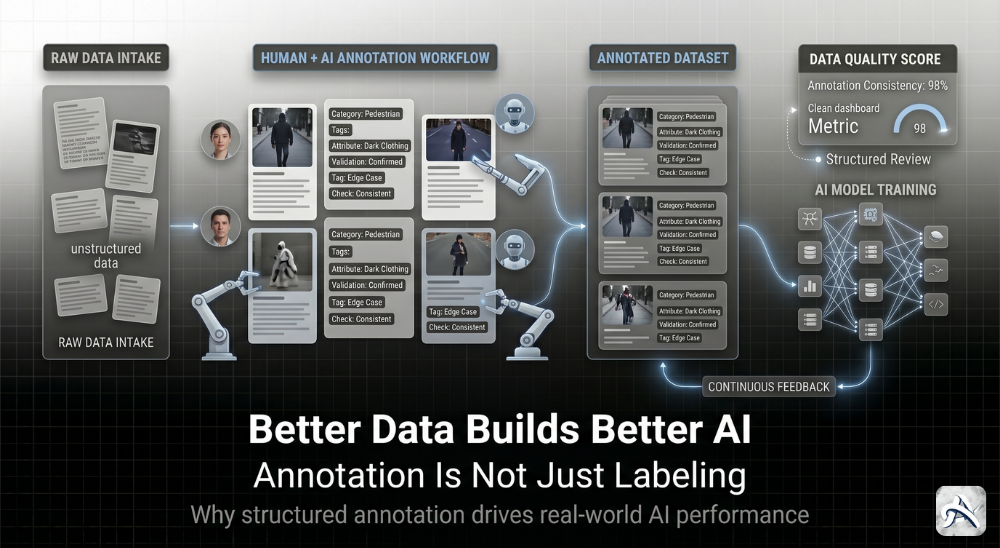
By shifting from naive programmatic extraction to a rigorous four-stage pipeline—structural normalization, Locality-Sensitive Hashing (LSH) deduplication, automated PII sanitization, and hierarchical layout-aware chunking—the engineering team eliminated 23.9% redundant volume, improved context recall from 61.2% to 84.7%, and eradicated sensitive data leakage without degrading domain context.
The Challenge: The Hidden Costs of Naive Extraction
Enterprise data lakes contain thousands of multi-page PDF reports, slide decks, spreadsheet extracts, and markdown technical specs. Naive programmatic scrapers (such as standard unformatted text dumps) produce massive structural corruption:
Need AI or Software Engineering Support?
Turn your ideas and technical challenges into reliable, scalable solutions with Acadify. From AI development and automation to software engineering and product development, we help businesses build and grow with confidence.
- Loss of Document Geometry: Multi-column layouts, callout boxes, and headers/footers bleed into body prose, creating hallucination-inducing noise.
- Corpus Redundancy: Near-duplicate documents (draft iterations, repeated legal disclaimers, email chains) bloat the vector index, diluting retrieval relevance.
- Compliance Violations: Hardcoded credentials, internal API keys, customer names, and PII slip into training sets and embedding databases.
- Context Fragmentation: Arbitrary fixed-length character chunking severs tables and sentences midway, divorcing specific statements from their qualifying sections.
The Four-Stage Production Pipeline
Stage 1: Layout-Aware Structural Normalization
Raw artifacts are first parsed through a vision-assisted document layout engine. Rather than treating files as raw text streams, documents are segmented into structural elements: document titles, H1-H4 headings, paragraph blocks, tables, and caption items. Running headers, page numbers, and boilerplate legal disclaimers are programmatically stripped.
Stage 2: Scalable Deduplication with MinHash LSH
To identify both exact and near-duplicate documents across millions of records without an O(N²) comparison overhead, the pipeline implements MinHash with Locality-Sensitive Hashing (LSH):
- Shingling: Text is tokenized into 5-word character n-grams.
- MinHash Fingerprinting: 128 independent hash functions compute dense signature vectors.
- LSH Banding: Signatures are partitioned into bands to quickly identify pairs exceeding a 0.85 Jaccard similarity threshold.
This stage removed over 573,000 near-duplicate artifacts (23.9% corpus reduction), drastically reducing downstream embedding computation and vector database footprint.
Stage 3: Two-Tier Automated PII Sanitization
Data privacy compliance requires zero-tolerance leakage mitigation while preserving syntactic readability. We implemented a two-tier hybrid sanitization engine:
- Tier 1 (Deterministic Regex): High-throughput detection of high-entropy strings, API tokens, IP addresses, credit cards, and social security identifiers.
- Tier 2 (Contextual NER via Microsoft Presidio): SpaCy-backed transformer entities detecting contextual person names, phone numbers, and enterprise customer identifiers, masking them into normalized canonical tokens (e.g.,
[PERSON_1],[CLIENT_ORG]).
Stage 4: Hierarchical Layout-Aware Chunking & Breadcrumb Prepending
Standard fixed-size chunking (e.g., 512 tokens with 50-token overlap) causes catastrophic context loss. We replaced it with semantic boundary chunking combined with Breadcrumb Prepending:
Each chunk is prefixed with its document-level taxonomy and parent heading path before embedding generation:
[Document: 2025 Architecture Strategy > Section: Disaster Recovery > Subsection: Failover SLAs]
In the event of primary region disruption, cross-region failover initiates within 120 seconds...
By guaranteeing that every embedding contains its semantic hierarchy, dense retrieval vectors maintain precise contextual alignment even when chunk text is concise.
Empirical Results & Evaluation Benchmarks
The updated pipeline was evaluated against a held-out benchmark suite of 1,200 enterprise domain queries across our RAG evaluation testbed:
| Metric | Naive Scraped Baseline | Production 4-Stage Pipeline | Delta |
|---|---|---|---|
| Total Artifacts Processed | 2,400,000 | 1,827,000 (after dedup) | -23.9% Index Size |
| Top-5 Context Recall | 61.2% | 84.7% | +23.5% |
| RAG Faithfulness / Hallucination-Free | 72.4% | 91.8% | +19.4% |
| PII Leakage Incidents | 142 detected | 0 detected | 100% Mitigation |
| Vector DB Ingestion Latency | 38.4 hours | 14.1 hours | -63.3% Cost & Time |
Key Takeaways & Engineering Post-Mortem
- Data quality eclipses model parameter size: Enhancing the dataset preparation pipeline delivered larger gains in context recall and factual faithfulness than upgrading model size from 8B to 70B parameters on raw data.
- Structural breadcrumbs solve needle-in-haystack retrieval: Prepending document hierarchy anchors dense embeddings to high-level entities without exceeding context budgets.
- Deduplication is a prerequisite for RAG: Near-duplicate chunks dilute top-k similarity search, starving generative LLMs of diverse, informative context chunks.
- Enforce deterministic lineage: Storing cryptographic hash manifests for every transformation stage ensures pipeline runs are audit-ready, reproducible, and verifiable.
Glossary & Key Architecture Definitions
- • MinHash LSH: An algorithmic technique combining hash functions and Locality-Sensitive Hashing to estimate Jaccard similarity and deduplicate documents at scale.
- • Context Recall: The proportion of ground-truth reference statements or documents that were successfully retrieved into the model context window.
- • Breadcrumb Prepending: Prepending document-level taxonomy and section headings to individual chunk texts to retain structural context.
Engineering Research & Citations
- [1] Lee et al., 'Deduplicating Training Data Makes Language Models Better', ACL 2022.
- [2] Great Expectations Core Documentation, Data Quality Architecture (2025/2026).
- [3] Microsoft Presidio Open-Source PII Anonymization Framework.

No perspectives submitted yet. Be the first to start the discussion.