

Executive Summary & Key Takeaways
Key Insights- AI automation transcends traditional RPA by utilizing foundational models to process unstructured text, scanned documents, and ambiguous natural language inputs.
- Multi-agent orchestration enables complex enterprise workflows by dividing tasks among specialized cooperative agents with cross-verification loops.
- Deterministic API gateways and schema validation guardrails are essential to prevent autonomous agents from executing unverified database transactions.
- Hybrid human-in-the-loop (HITL) gating ensures operational safety by routing low-confidence decisions to human reviewers.
- Balancing reasoning depth with execution latency is critical for maintaining real-time responsiveness in high-concurrency enterprise pipelines.
Quick Definition / Direct Answer
Direct SummaryEnterprise AI automation replaces rigid robotic process automation with cognitive, multi-agent workflows capable of parsing unstructured data, executing deterministic API actions, and driving measurable operational efficiency under strict human-in-the-loop governance.
Enterprise automation has undergone a fundamental architectural transformation. Traditional robotic process automation (RPA) and rigid deterministic scripts are rapidly being superseded by intelligent AI automation systems capable of dynamic reasoning, unstructured document comprehension, and multi-agent workflow orchestration. For CTOs and engineering leaders, moving from static rule-based macros to adaptive cognitive automation represents the definitive threshold for operational scalability and efficiency in modern enterprise environments.
This comprehensive research report examines the architectural paradigms, implementation frameworks, reliability challenges, and measurable ROI associated with deploying enterprise-grade AI automation pipelines.
The Evolution from Deterministic RPA to Cognitive AI Automation
First-generation enterprise automation relied heavily on rigid script execution, fixed API contracts, and predictable structured data inputs. When presented with UI shifts, unformatted PDF invoices, or ambiguous customer intent, legacy RPA tools frequently failed or required extensive manual intervention.
Need AI or Software Engineering Support?
Turn your ideas and technical challenges into reliable, scalable solutions with Acadify. From AI development and automation to software engineering and product development, we help businesses build and grow with confidence.
Cognitive AI automation replaces fragile hardcoded rules with probabilistic foundational models, embedding spatial-semantic understanding, dynamic error recovery, and autonomous decision-making directly into business workflows.
| Scaling Dimension | Early-Stage Monolith Pattern | Enterprise Scaled Architecture |
|---|---|---|
| Data Persistence | Single monolithic relational database instance with direct queries | Read replicas, connection poolers (PgBouncer), sharding, and caching layers |
| Compute Layer | Vertical scaling (larger virtual machine instances) | Horizontal autoscaling across containerized microservices in Kubernetes |
| Asynchronous Tasks | Synchronous HTTP request-response execution blocks | Event-driven message brokers (Kafka, RabbitMQ) and distributed workers |
| State Management | In-memory session storage or sticky sessions | Stateless application nodes with centralized Redis session stores |
Core Architectural Components of AI Automation
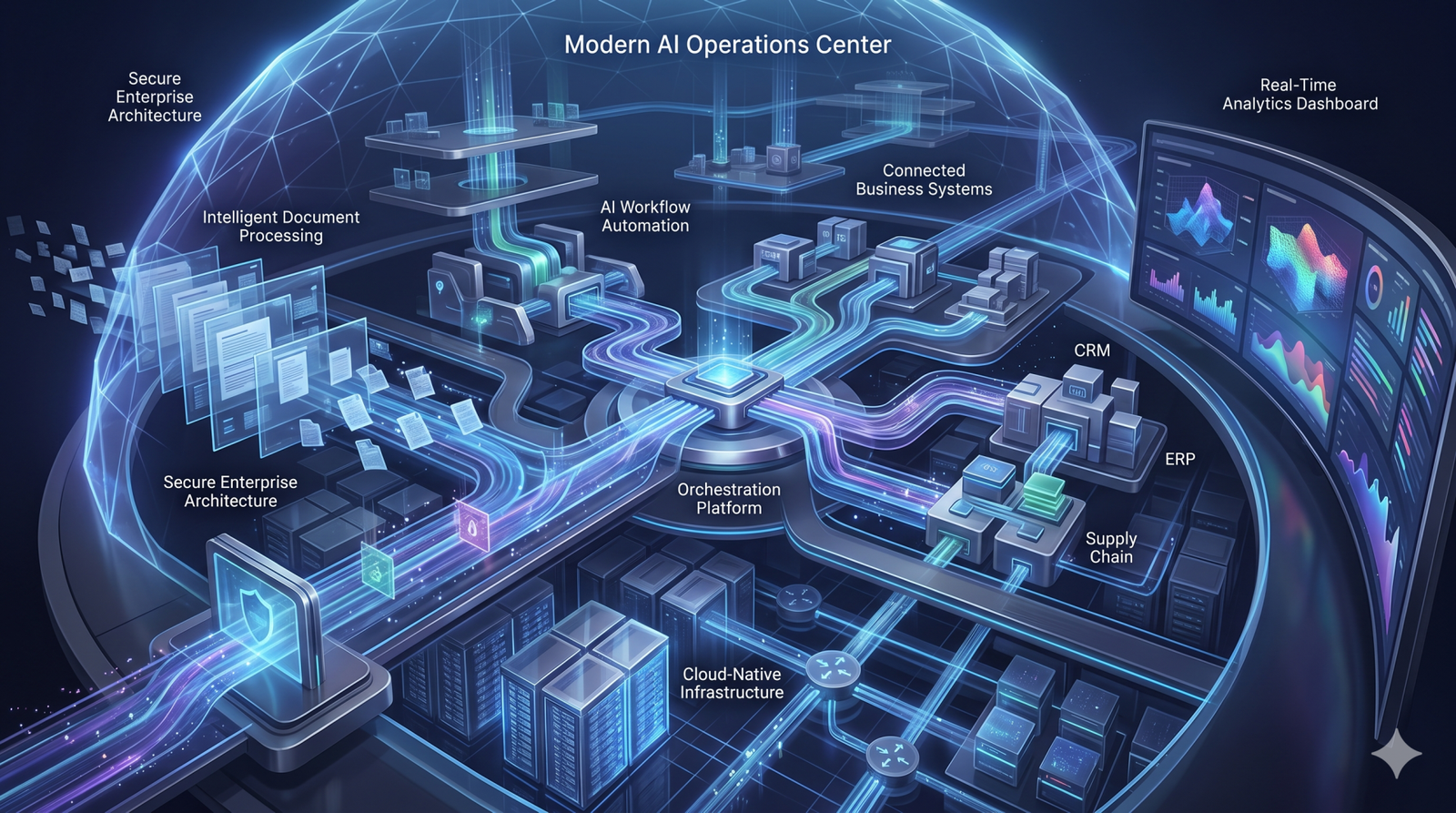
Building a resilient enterprise automation pipeline requires integrating several specialized infrastructural layers to ensure transactional integrity and operational reliability.
1. Multimodal Data Ingestion and Semantic Chunking
Enterprise workflows begin with messy, heterogeneous inputs. Automated pipelines must ingest unstructured documents, parse complex tables and figures, and apply semantic chunking algorithms before indexing content into vector databases or passing context windows to downstream language models.
2. Autonomous Multi-Agent Orchestration
Complex enterprise tasks—such as financial auditing, cross-system customer onboarding, or automated code refactoring—cannot be reliably executed in a single monolithic prompt. Modern architectures deploy decentralized multi-agent topologies where specialized agents (e.g., researcher, validator, executor) collaborate, debate, and verify intermediate outputs.
3. Deterministic Guardrails and API Gateways
While generative models provide cognitive flexibility, executing database transactions or external API calls requires absolute determinism. AI automation architectures enforce strict semantic firewalls and schema validation layers (such as JSON schema checking and Rego-based OPA policies) before any automated agentic action is permitted to execute.
Step-by-Step Implementation Framework
Enterprise engineering teams should follow a structured phased roadmap when deploying AI automation workflows:
- Workflow Audit & Feasibility Scoping: Identify high-volume, repetitive, unstructured workflows where human cognitive fatigue creates bottlenecks and error risks.
- Golden Dataset Curation: Assemble 150+ representative edge-case historical test payloads to benchmark baseline accuracy before releasing automation agents into staging environments.
- Hybrid Human-in-the-Loop (HITL) Gating: Implement confidence-score thresholds where high-confidence transactions execute autonomously while low-confidence edge cases are routed to human reviewers.
- Continuous Observability & Drift Monitoring: Track token latency, API failure rates, cost per execution, and semantic accuracy shifts in real-time.
Implementation Trade-Offs and Enterprise Risks
Deploying autonomous AI automation introduces distinct technical and operational trade-offs:
- Execution Latency vs. Reasoning Depth: Multi-step agentic reflection loops significantly improve output accuracy but increase end-to-end execution latency from milliseconds to several seconds per transaction.
- Hallucination Propagation in Chains: In multi-agent pipelines, a minor hallucination or incorrect argument extraction in an upstream agent can cascade through downstream execution steps, resulting in corrupted automated outcomes. For related architectural mitigation strategies, review our technical guide on AI Reliability Engineering for Enterprise LLM Systems.
Frequently Asked Questions
What is AI automation?
AI automation is the use of artificial intelligence technologies—including large language models, computer vision, and autonomous agents—to execute complex, unstructured, and multi-step business workflows without constant human intervention.
How does AI automation differ from traditional robotic process automation (RPA)?
Traditional RPA executes rigid, deterministic macros based on fixed rules and structured data. AI automation handles unstructured inputs, interprets ambiguous context, makes probabilistic decisions, and adapts dynamically to workflow variations.
What are the primary security risks in enterprise AI automation?
Primary risks include indirect prompt injection attacks hidden within ingested documents, unauthorized API tool executions, unmasked personally identifiable information (PII) leakage, and cascading hallucinations in multi-agent loops.
How can enterprises measure the ROI of AI automation?
Enterprise ROI is measured by quantifying reduced task completion times, decreased error correction overhead, lowered operational labor costs, and accelerated transaction throughput across core business operations.
What role does human-in-the-loop (HITL) play in automated workflows?
HITL serves as an essential safety gate, automatically routing low-confidence decisions or high-risk financial transactions to human experts for validation while letting high-confidence routine tasks execute autonomously.
Glossary & Key Architecture Definitions
- • AI Automation: The application of machine learning, natural language processing, and autonomous agents to execute end-to-end business workflows requiring cognitive reasoning and unstructured data processing.
- • Multi-Agent Orchestration: An architectural design where specialized autonomous AI agents cooperate, divide tasks, and cross-verify results to accomplish complex enterprise objectives.
- • Cognitive Automation: Advanced automation that mimics human cognitive functions—such as reading comprehension, contextual reasoning, and decision-making—across variable datasets.
- • Human-in-the-Loop (HITL): A hybrid operational model where automated AI systems pause for human verification or intervention when confidence scores fall below predefined thresholds.
- • Prompt Injection: An adversarial attack vector where malicious instructions are embedded within untrusted input data to override an AI system's original operational constraints.
Engineering Research & Citations
- [1] Gartner Research: Enterprise Automation and Hyperautomation Strategic Trends.
- [2] McKinsey & Company: The Economic Potential of Generative AI and Workplace Automation.
- [3] IEEE Computer Society: Autonomous Multi-Agent Orchestration and Workflow Reliability in Enterprise Systems.
- [4] National Institute of Standards and Technology (NIST): AI Risk Management Framework for Automated Systems.
No perspectives submitted yet. Be the first to start the discussion.