Client Overview
- Industry: FinTech
- Company Type: Digital Lending Platform
- Region: North America
- Project Type: Risk Assessment Automation & Loan Processing Modernization
- Technology Stack: Next.js, NestJS, PostgreSQL, OpenAI, Vector Database, AWS, Redis, Custom RAG Architecture
Executive Summary
A rapidly growing digital lending platform was struggling to scale its loan review operations.
Loan officers spent significant time manually reviewing financial documents, verifying applicant information, checking policy compliance, and assessing lending risk across multiple disconnected systems.
As application volumes increased, processing delays became a serious business bottleneck.
Need MVP Development or AI Solutions?
Turn your idea into reality with Acadify. Fast, scalable, and built for enterprise growth.
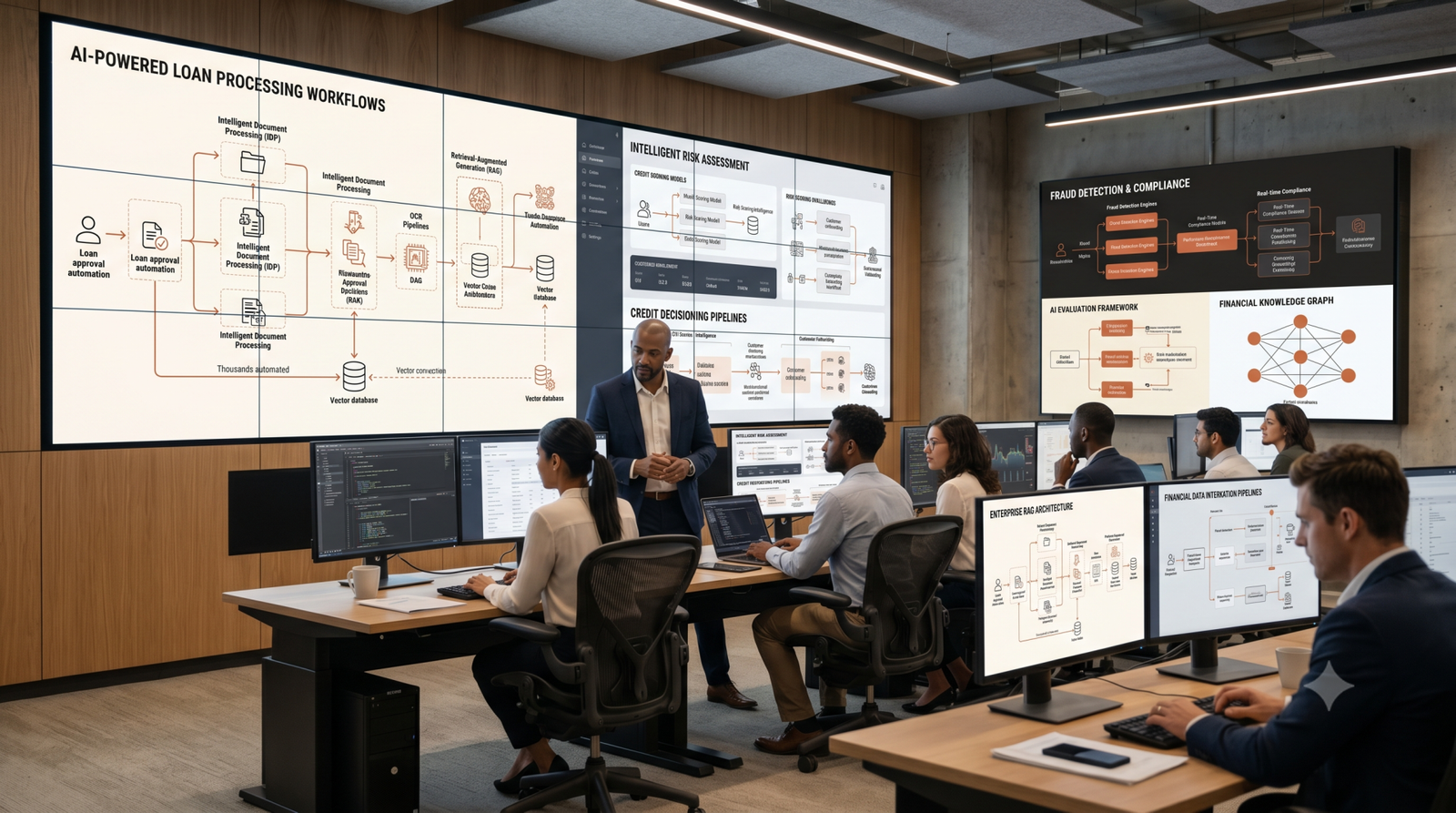
Acadify Solution designed and deployed a custom Retrieval-Augmented Generation (RAG) architecture that automated document intelligence, risk analysis support, policy retrieval, and decision-assistance workflows.
The result was an 80% reduction in average loan processing time while improving operational consistency and increasing underwriting capacity without expanding the review team.
The Challenge
The client experienced rapid growth in loan application volume following a successful expansion into new markets.
Their underwriting workflow relied heavily on manual processes.
Each application required analysts to review:
- Bank statements
- Income documents
- Credit reports
- Risk policies
- Internal lending guidelines
- Historical approval patterns
- Compliance requirements
Information was distributed across multiple systems and repositories.
Analysts spent more time gathering information than evaluating risk.
Several operational issues emerged:
- Loan approvals frequently delayed
- Increasing operational costs
- Underwriting team overload
- Knowledge retrieval inefficiencies
- Inconsistent policy interpretation
- Growing customer dissatisfaction
- Difficulty scaling operations
Management faced a critical question:
How could they increase loan volume without proportionally increasing headcount?
Initial Assessment
Acadify Solution conducted a workflow analysis across underwriting operations.
The findings revealed three major bottlenecks.
Knowledge Fragmentation
Critical lending policies were scattered across internal documents, compliance manuals, training resources, and operational guidelines.
Analysts frequently searched multiple sources before making decisions.
Document Review Delays
Large portions of underwriting time were spent manually extracting information from financial documents.
Valuable analyst expertise was consumed by repetitive tasks.
Decision Consistency Challenges
Different analysts occasionally interpreted policy requirements differently, creating operational variability.
The organization needed stronger decision support without removing human oversight.
The Solution
Instead of replacing human underwriters, we designed an AI-assisted risk intelligence platform powered by a custom RAG architecture.
The objective was augmentation, not automation for its own sake.
Custom Knowledge Layer
We created a centralized knowledge system containing:
- Lending policies
- Compliance requirements
- Risk frameworks
- Operational procedures
- Historical underwriting guidance
- Internal approval standards
Documents were processed, structured, embedded, and indexed within a vector retrieval system.
Intelligent Document Processing
The platform automatically analyzed submitted documents and extracted relevant financial indicators.
Rather than forcing analysts to manually locate critical information, the system surfaced relevant insights automatically.
Context-Aware Retrieval
The RAG engine retrieved applicable policies and lending rules based on the specific characteristics of each application.
This significantly reduced manual research time.
Risk Intelligence Dashboard
A centralized dashboard presented:
- Applicant summaries
- Risk indicators
- Policy references
- Compliance considerations
- Supporting evidence
- Recommended review priorities
Underwriters maintained final decision authority while benefiting from dramatically improved information access.
Architecture Overview
Data Ingestion Layer
- Financial documents
- Credit data
- Policy repositories
- Compliance resources
- Historical decisions
Processing Layer
- Document parsing
- Data normalization
- Embedding generation
- Metadata enrichment
Retrieval Layer
- Vector search
- Semantic ranking
- Policy retrieval
- Context assembly
Intelligence Layer
- Risk analysis support
- Decision assistance
- Compliance validation
- Workflow recommendations
Observability Layer
- Retrieval monitoring
- Response evaluation
- Audit logging
- Performance analytics
Implementation Strategy
One of the biggest concerns was maintaining regulatory confidence.
The client could not deploy a black-box decision engine.
Every recommendation required transparency and traceability.
We implemented a human-in-the-loop workflow where AI-generated insights always included supporting references and source attribution.
This approach improved trust among underwriting teams and compliance stakeholders.
Results
After deployment, the organization observed measurable operational improvements.
80% Reduction in Loan Processing Time
Average review time dropped dramatically as analysts spent less time searching for information and more time evaluating applications.
3.2x Increase in Underwriting Capacity
The existing team processed significantly more applications without requiring additional hiring.
41% Faster Policy Retrieval
Analysts gained immediate access to relevant guidelines and compliance requirements.
Improved Decision Consistency
Context-aware retrieval reduced interpretation variability across underwriting teams.
Enhanced Customer Experience
Faster approval cycles improved applicant satisfaction and reduced abandonment rates.
Key Lessons
AI Works Best When It Augments Experts
The most successful automation initiatives do not eliminate human expertise. They amplify it.
By reducing repetitive research and document review tasks, analysts could focus on higher-value risk evaluation.
RAG Outperformed Generic AI Approaches
Access to verified organizational knowledge proved significantly more valuable than relying solely on model reasoning.
Retrieval quality became a critical success factor.
Observability Was Essential
Enterprise AI systems require continuous monitoring.
Tracking retrieval accuracy, policy coverage, and workflow performance helped maintain trust and reliability after deployment.
Conclusion
Many financial institutions attempt to accelerate underwriting by adding more analysts.
This approach increases operational costs without fundamentally improving efficiency.
The client achieved a different outcome.
By combining product engineering, workflow automation, and a custom RAG architecture, they transformed loan processing into a scalable intelligence-driven operation.
At Acadify Solution, we help fintech organizations move beyond AI experimentation and build production-ready systems that deliver measurable business outcomes.
This project demonstrates that when AI is integrated into the right workflow with the right architecture, operational improvements can be substantial, measurable, and sustainable.
No perspectives submitted yet. Be the first to start the discussion.