

Executive Summary & Key Takeaways
Key Insights- Hybrid retrieval can combine lexical precision with semantic recall; authorization belongs before model context; reranking should be measured against latency; retrieval and generation need separate evaluation; document freshness and versioning are production concerns; every response should be traceable to retrieved evidence.
Quick Definition / Direct Answer
Direct SummaryEnterprise RAG architecture connects governed enterprise data to retrieval, authorization, ranking, and model generation so responses are grounded in relevant evidence. A production design combines structured ingestion, metadata and permission filters, hybrid keyword and vector retrieval, optional reranking, separate retrieval and answer evaluation, document lifecycle management, and traceable observability.
What is enterprise RAG architecture?
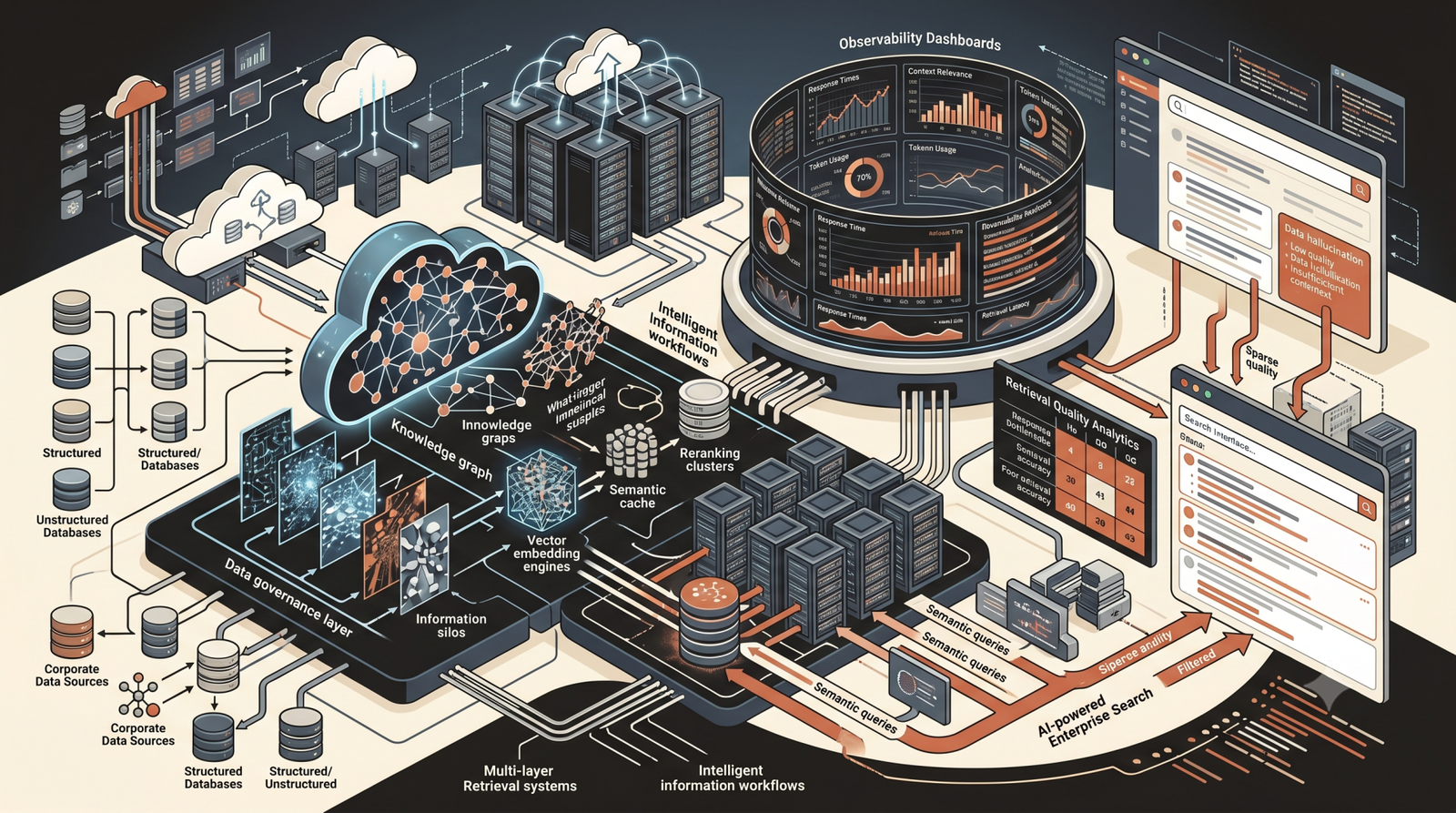
Enterprise RAG architecture is the system design that connects business data to a retrieval layer, applies identity and access controls, selects relevant evidence, and passes that evidence to a language model for grounded responses. A production design must treat ingestion, retrieval, authorization, generation, observability, and evaluation as one system rather than treating the vector database as the architecture.
Retrieval-augmented generation (RAG) adds external information to a model's context at request time. AWS describes production RAG as a workflow that includes connectors, data processing, indexing, retrieval, and generation. Microsoft similarly separates the retrieval phase from the end-to-end generation and evaluation phases. AWS Prescriptive Guidance and Microsoft's RAG architecture guidance both emphasize that production quality depends on the full pipeline, not only embeddings.
For enterprise workloads, the architecture also needs to answer practical questions: Which documents may this user retrieve? How are stale documents removed? What happens when keyword search and vector search disagree? When should results be reranked? How is retrieval quality measured? Can every answer be traced back to source evidence?
Need AI or Software Engineering Support?
Turn your ideas and technical challenges into reliable, scalable solutions with Acadify. From AI development and automation to software engineering and product development, we help businesses build and grow with confidence.
Key takeaways
- Design the ingestion, retrieval, authorization, generation, and monitoring layers together.
- Use metadata and permission filters before retrieved content reaches the model.
- Hybrid retrieval can combine exact-term matching with semantic similarity.
- Reranking improves precision but adds latency and should be measured.
- Evaluate retrieval separately from answer generation so failures have a clear owner.
- Log document versions, retrieval results, model inputs, outputs, latency, and safety events.
- Treat the knowledge base as a continuously maintained production dependency.
Enterprise RAG reference architecture
Enterprise Sources
  |-- SharePoint / Drive / SaaS
  |-- Databases / APIs
  |-- PDFs / Office files / Web content
          |
          v
+-----------------------+
| Ingestion & Processing|
| parse -> clean -> ACL |
| metadata -> chunk     |
+-----------+-----------+
            |
            v
+-----------------------+
| Search Index          |
| text + vectors        |
| metadata + permissions|
+-----------+-----------+
            |
User -> Identity -> Query Processing
                    |
                    v
          +------------------+
          | Hybrid Retrieval |
          | keyword + vector |
          +--------+---------+
                   |
                   v
             Reranking
                   |
                   v
          Permission Check
                   |
                   v
        Context / Citation Builder
                   |
                   v
              LLM / Model
                   |
                   v
       Response + Citations
                   |
                   v
      Observability + Evaluation
The important architectural property is controlled evidence flow. Source material should be transformed into retrievable units with metadata, filtered according to the requester's permissions, ranked for relevance, and only then assembled into model context.
1. Build the ingestion layer before tuning retrieval
Retrieval quality cannot compensate for poor source preparation. Enterprise repositories contain PDFs, presentations, spreadsheets, HTML, scanned documents, tickets, database records, and application data. Each source can require a different extraction and normalization strategy.
The ingestion pipeline should usually perform these stages:
- Connect to the source system.
- Extract text and structural information.
- Normalize encoding, whitespace, and document artifacts.
- Preserve headings, tables, lists, page or section boundaries where useful.
- Attach metadata such as source, owner, document type, date, tenant, and access policy.
- Create chunks based on semantic and structural boundaries.
- Generate embeddings where vector retrieval is used.
- Write the resulting records to the search index.
- Record document version and ingestion status.
Do not assume every document should be chunked with the same fixed character count. A policy section, API reference, financial table, and support ticket have different retrieval boundaries. Your existing RAG data preparation guide covers this ingestion and chunking problem in greater depth.
2. Treat metadata as part of retrieval
Metadata is not decoration. It can determine whether a result is relevant, permitted, current, or applicable to a particular business context.
| Metadata | Typical use |
|---|---|
| source_id | Trace the result back to the originating record. |
| document_version | Prevent outdated evidence from silently winning retrieval. |
| tenant_id | Isolate customer or organizational data. |
| access_policy | Apply authorization-aware filtering. |
| document_type | Prioritize or restrict policies, contracts, tickets, manuals, and other sources. |
| effective_date | Prefer current policies and time-sensitive material. |
| language | Route or filter multilingual content appropriately. |
Metadata filtering should happen as close to retrieval as the platform permits. Filtering after the model has already received unauthorized context is too late.
3. Use hybrid retrieval when both meaning and exact terms matter
Vector retrieval is useful for conceptual similarity, but enterprise questions often contain exact identifiers: product codes, policy names, contract numbers, error codes, names, dates, or technical terms. Keyword retrieval can perform better for these cases.
Hybrid retrieval combines keyword and vector search and merges their ranked results. Microsoft documents hybrid search as parallel full-text and vector queries followed by Reciprocal Rank Fusion (RRF). This provides a practical way to combine lexical precision with semantic recall. Microsoft's hybrid search documentation explains the pattern and its trade-offs.
A useful baseline is:
- Run keyword retrieval.
- Run vector retrieval.
- Apply security and business filters.
- Fuse the candidate lists.
- Rerank the best candidates if the workload benefits from it.
- Pass only the strongest evidence into the generation layer.
4. Understand RRF before adding complex ranking logic
Reciprocal Rank Fusion combines ranked lists by using the positions of documents rather than requiring the underlying search scores to have the same scale. That makes it useful when lexical and vector systems produce fundamentally different scores.
RRF is a candidate-fusion mechanism, not a guarantee that the final result answers the user's question. A document can rank highly because it is lexically or semantically related while still failing to contain the required evidence. That is why a second-stage reranker or answer-level evaluator can be valuable.
5. Add reranking when retrieval precision is the bottleneck
Initial retrieval generally optimizes for recall: retrieve enough candidates that the relevant evidence is present. Reranking can then optimize for precision by reordering those candidates based on query-aware relevance.
Microsoft's RAG architecture guidance describes reranking as a way to move the most relevant chunks to the top after broader retrieval. It also notes the important trade-off: reranking introduces additional processing and therefore additional latency. Microsoft's retrieval guidance recommends evaluating the relevance benefit against the latency cost.
| Layer | Primary objective | Typical failure |
|---|---|---|
| Keyword retrieval | Exact-term relevance | Misses semantic equivalents |
| Vector retrieval | Semantic recall | Returns broadly related content |
| Hybrid fusion | Combine retrieval signals | Candidate ordering is still imperfect |
| Reranking | Query-aware precision | Extra latency and cost |
| Generation | Produce a useful grounded answer | Unsupported or incomplete response |
6. Make authorization part of the retrieval path
Enterprise RAG introduces a security problem that ordinary public search does not: the best document for a question may not be a document the current user is allowed to see.
Model-level instructions such as “do not reveal confidential information” are not a substitute for access control. The retrieval layer should carry the user's identity, tenant, role, group, or entitlement context and enforce the appropriate filters before evidence is assembled.
A safer request path is:
authenticated user
      |
      v
identity + entitlements
      |
      v
query + security filters
      |
      v
retrieval
      |
      v
authorized candidates
      |
      v
reranking
      |
      v
model context
For high-sensitivity systems, also consider tenant isolation, encryption, secrets management, audit logging, network boundaries, retention rules, and controls against indirect prompt injection embedded in retrieved documents.
7. Separate retrieval quality from answer quality
A RAG answer can fail for two very different reasons. The search layer may have failed to retrieve the right evidence, or the model may have received good evidence but produced a poor answer. Measuring only final answer quality hides this distinction.
Evaluate at least two layers:
- Retrieval evaluation: Did the relevant source appear in the candidate set, and how highly was it ranked?
- Generation evaluation: Did the final answer correctly use the retrieved evidence and satisfy the user's request?
Microsoft's retrieval guidance identifies metrics such as Precision@K, Recall@K, and Mean Reciprocal Rank for retrieval evaluation. Microsoft also provides dedicated RAG evaluators for document retrieval and other RAG quality dimensions. Microsoft's RAG evaluator documentation provides examples of process and system-level evaluation.
8. Create a representative retrieval test set
A retrieval benchmark should reflect real work rather than only easy questions written by the development team. Include queries that exercise different failure modes.
| Test type | Example purpose |
|---|---|
| Exact lookup | Find a policy number, product code, or named procedure. |
| Semantic query | Find information expressed with different terminology. |
| Multi-hop query | Require evidence from more than one source. |
| Ambiguous query | Test whether the system asks for clarification or retrieves safely. |
| Negative query | Verify that the system does not invent evidence when the corpus lacks an answer. |
| Permission query | Verify that restricted documents never enter the candidate context. |
| Freshness query | Confirm that current policies outrank obsolete versions. |
9. Measure the full production path
Offline relevance metrics are necessary but insufficient. A production RAG service also has latency, cost, availability, security, and user-experience requirements.
Track metrics such as:
- Retrieval latency and end-to-end latency.
- Top-K retrieval metrics and reranker performance.
- Groundedness and answer correctness.
- Empty-result and low-confidence rates.
- Token consumption and generation cost.
- Timeouts, retries, and provider errors.
- Permission-filter failures and security events.
- Source freshness and ingestion failures.
- User feedback and escalations.
Your enterprise AI observability guide covers the broader monitoring layer. The RAG-specific requirement is to retain enough retrieval context to reconstruct why a particular answer was produced.
10. Design traceability into every response
A production response should be traceable to the retrieval event that produced it. A useful trace can contain a request ID, user or tenant context where appropriate, query representation, retrieved document IDs, ranks, scores, reranking results, model version, prompt or template version, latency, and final response metadata.
Do not log sensitive document contents indiscriminately. Logging should follow the same data-classification, access-control, retention, and redaction policies as the underlying enterprise system.
11. Manage freshness and document lifecycle
Enterprise knowledge changes. Policies are revised, product documentation is replaced, contracts expire, and access rights change. A RAG index that only grows becomes progressively less trustworthy.
Use lifecycle states such as:
- active and searchable
- superseded but retained for audit
- expired and excluded from normal retrieval
- deleted and removed according to retention policy
- pending ingestion or validation
Document versioning should be explicit enough that the system can explain which version supported an answer. Where effective dates matter, retrieval should favor the applicable version instead of simply choosing the newest file.
12. Keep the retrieval and generation layers independently testable
A modular architecture makes failures easier to isolate. The retrieval service should be testable with a query and expected evidence without invoking a language model. The generation layer should be testable against controlled context without depending on a live search index.
This separation also makes optimization safer. You can change an embedding model, chunking policy, search engine, reranker, or model provider and compare results against the same evaluation suite.
13. Avoid these common RAG architecture mistakes
| Mistake | Why it fails | Better approach |
|---|---|---|
| “Just add a vector database” | Ignores ingestion, permissions, ranking, freshness, and evaluation. | Design the complete evidence pipeline. |
| One chunk size for every source | Document structures and query patterns differ. | Use structure-aware chunking and measure retrieval. |
| Vector search only | Exact identifiers and terminology can be missed. | Benchmark hybrid retrieval. |
| Huge top-K context | Adds noise, latency, and cost. | Retrieve broadly, rerank, then keep focused evidence. |
| Security after generation | Unauthorized data may already have reached the model. | Filter before context construction. |
| Evaluate only final answers | Retrieval failures and generation failures are mixed together. | Evaluate retrieval and generation separately. |
| No document versioning | Obsolete evidence can remain competitive. | Track versions, status, and effective dates. |
| No production feedback loop | Real failures never improve the benchmark. | Turn incidents and feedback into regression cases. |
14. When classic RAG is enough
Not every application needs an agentic retrieval architecture. A conventional pipeline can be a strong choice when the query is relatively direct, the knowledge sources are well understood, and predictable latency and operational simplicity matter.
Microsoft's current RAG guidance distinguishes classic RAG from more advanced agentic retrieval approaches. Classic RAG can remain appropriate when simplicity and control are priorities. More complex retrieval planning can be useful for conversational, multi-step, or multi-source questions when measured relevance justifies the additional complexity.
15. A practical production implementation plan
- Map sources: identify systems, owners, formats, permissions, and freshness requirements.
- Build ingestion: parse, normalize, chunk, enrich, version, and index documents.
- Establish authorization: propagate identity and enforce access filters before retrieval results enter model context.
- Create a test set: include positive, negative, ambiguous, freshness, and permission-sensitive queries.
- Baseline retrieval: compare keyword, vector, and hybrid approaches.
- Add reranking selectively: measure relevance improvement against latency and cost.
- Build generation evaluation: test correctness, groundedness, citation quality, and refusal behavior.
- Instrument production: capture retrieval traces, latency, errors, feedback, and source versions.
- Automate regression: run the evaluation suite whenever ingestion, retrieval, prompts, models, or ranking configuration changes.
- Operate the knowledge lifecycle: continuously handle updates, removals, permissions, and stale content.
Enterprise RAG architecture checklist
- Source connectors are identified and monitored.
- Document extraction preserves useful structure.
- Chunks have stable IDs and source references.
- Metadata includes security and lifecycle attributes.
- Access control is enforced before context construction.
- Keyword and vector retrieval are benchmarked.
- Reranking is measured rather than assumed.
- Retrieval metrics are tracked independently from answer metrics.
- Freshness and document versions are managed.
- Responses can be traced to source evidence.
- Production failures feed a regression dataset.
- Latency, cost, availability, and security events are monitored.
Frequently asked questions
What is the best architecture for enterprise RAG?
There is no universal best architecture. A strong baseline is controlled ingestion, metadata-aware indexing, permission-filtered hybrid retrieval, optional reranking, grounded generation, and continuous evaluation and observability. The right components should be selected using representative workload measurements.
Is vector search enough for enterprise RAG?
Usually it should be benchmarked against hybrid retrieval rather than assumed to be sufficient. Exact names, identifiers, codes, and specialized terminology can benefit from lexical retrieval, while semantic queries benefit from vector retrieval.
Why does RAG retrieve the wrong documents?
Common causes include poor parsing, unsuitable chunk boundaries, missing metadata, weak query formulation, embedding mismatch, inadequate candidate depth, missing keyword retrieval, or lack of reranking. Retrieval evaluation helps identify which layer is responsible.
How should enterprise RAG security work?
Identity and authorization should be part of the retrieval path. Apply tenant, role, group, document, or policy filters before retrieved content is assembled into model context. Prompt instructions alone should not be treated as an access-control boundary.
How do you evaluate a RAG system?
Evaluate retrieval and generation separately. Retrieval can use metrics such as Precision@K, Recall@K, and MRR, while end-to-end evaluation can measure correctness, groundedness, citation quality, refusal behavior, latency, and user outcomes.
Conclusion
Production RAG is not primarily a vector database project. It is an evidence-management system that connects enterprise information to a model under retrieval, security, relevance, freshness, and operational constraints. The strongest architecture makes those constraints explicit and measurable.
If your organization is moving from a prototype to a production knowledge system, start with the retrieval contract: what evidence should be found, who may access it, how relevance will be measured, and how the system will prove which sources supported each response. Then optimize the search and generation layers against that contract.
For a concrete domain example, see the enterprise FinTech RAG case study, which illustrates how retrieval architecture can support an auditable underwriting workflow.
Related reading: RAG data preparation, enterprise chatbot architecture, production LLM evaluation, and why enterprise RAG systems miss expected ROI.
Glossary & Key Architecture Definitions
- • RAG: retrieval-augmented generation using external evidence at request time. Hybrid retrieval: combined keyword and vector search. Reranking: a second-stage process that reorders retrieved candidates for query-aware relevance. RRF: Reciprocal Rank Fusion for combining ranked result lists. Grounding: constraining generation with retrieved evidence. Retrieval evaluation: measurement of whether relevant evidence is found and ranked effectively.
Engineering Research & Citations
- [1] AWS Prescriptive Guidance — Understanding Retrieval Augmented Generation: https://docs.aws.amazon.com/prescriptive-guidance/latest/retrieval-augmented-generation-options/what-is-rag.html | Microsoft Learn — RAG and Generative AI: https://learn.microsoft.com/en-us/azure/search/retrieval-augmented-generation-overview | Microsoft Learn — Hybrid Search: https://learn.microsoft.com/en-us/azure/search/hybrid-search-overview | Microsoft Learn — RAG Information Retrieval: https://learn.microsoft.com/en-us/azure/architecture/ai-ml/guide/rag/rag-information-retrieval | Microsoft Learn — RAG Evaluators: https://learn.microsoft.com/en-us/azure/ai-foundry/concepts/evaluation-evaluators/rag-evaluators
No perspectives submitted yet. Be the first to start the discussion.