

Executive Summary & Key Takeaways
Key Insights- Evaluate the complete application; version representative datasets; separate retrieval, generation, safety, tools, and operational metrics; combine deterministic checks, model graders, and human review; run regression evaluations after relevant changes; connect thresholds to release decisions; feed production failures back into tests.
Quick Definition / Direct Answer
Direct SummaryProduction LLM regression testing repeatedly validates an LLM application after model, prompt, retrieval, tool, or code changes. This article focuses on versioned datasets, evaluator calibration, CI regression suites, failure taxonomies, and production-to-test feedback. For the broader LLM evaluation framework and metrics landscape, see https://acadifysolution.com/blogs/post/llm-evaluation-frameworks-metrics-production-guide. For the broader continuous-testing and CI/CD release-gate model, see https://acadifysolution.com/blogs/post/continuous-testing-business-growth-2026.
Direct Answer
Production LLM regression testing is the engineering practice of repeatedly validating an LLM application after prompts, models, retrieval, tools, or application code change. This guide focuses on implementation: versioned test datasets, evaluator calibration, CI regression suites, failure taxonomy, and production-to-test feedback. For the broader evaluation frameworks, metrics, and methodology landscape, see LLM Evaluation: Frameworks, Metrics & Production Testing Guide.
Key Takeaways
- Evaluate the application, not only the underlying model.
- Build representative datasets from real tasks and known failure modes.
- Separate retrieval, generation, safety, tool use, and operational metrics.
- Use deterministic checks where the expected answer or format is known.
- Use model graders carefully and calibrate them against human judgments.
- Run regression evaluations whenever prompts, models, retrieval, tools, or policies change.
- Turn evaluation thresholds into explicit release decisions.
1. Why Production Evaluation Is Different
A benchmark can tell you how a model performs on a public task. It cannot by itself tell you whether an enterprise application answers the right questions, retrieves authorized evidence, follows business rules, calls the correct tools, or remains stable after a prompt or model change.
Production evaluation therefore treats the complete application as the unit under test. The model is one component inside a larger workflow.
Need AI or Software Engineering Support?
Turn your ideas and technical challenges into reliable, scalable solutions with Acadify. From AI development and automation to software engineering and product development, we help businesses build and grow with confidence.
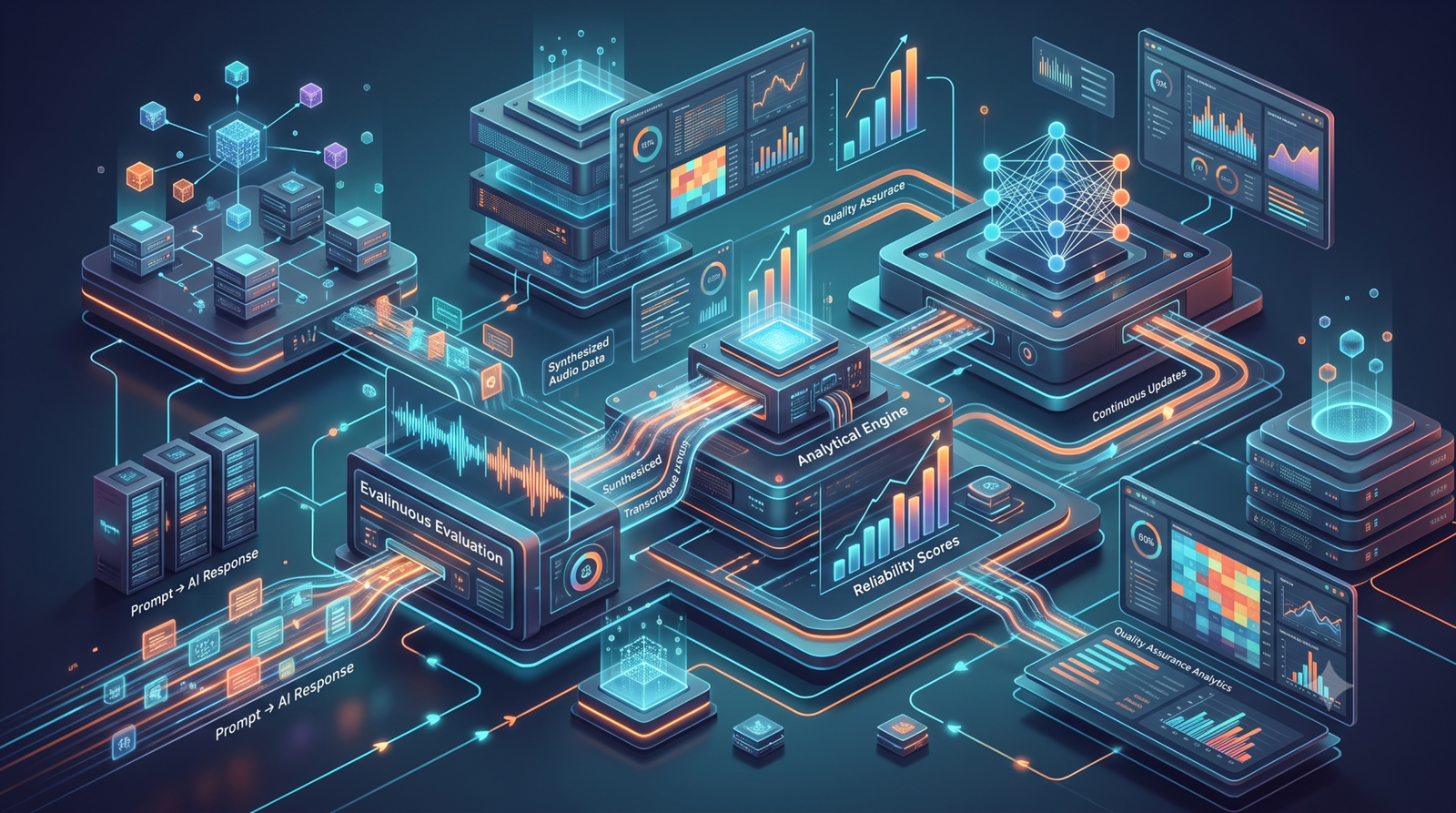
2. Evaluation Architecture
Production task examples
        |
        v
Evaluation dataset
        |
        +----> Expected outputs / criteria
        |
        v
Application under test
        |
        +----> Retrieval
        +----> Model
        +----> Tools
        +----> Guardrails
        |
        v
Trace + response
        |
        +----> Deterministic checks
        +----> Model graders
        +----> Human review
        |
        v
Metrics + failure taxonomy
        |
        v
Release / monitor / regress
This architecture makes evaluation repeatable and allows teams to compare application versions using the same evidence.
3. Build the Evaluation Dataset
The dataset is the foundation of an evaluation program. A small but representative dataset is more useful than a large collection of easy examples.
3.1 Start with real tasks
Collect representative requests from intended users, support tickets, workflows, domain experts, and controlled synthetic cases. Remove unnecessary sensitive information before using production examples.
3.2 Include failure cases
Include ambiguous requests, incomplete context, adversarial inputs, long inputs, edge cases, unsupported requests, and cases that previously caused incidents or poor user outcomes.
3.3 Version the dataset
Dataset changes can alter evaluation results. Store dataset versions and record which version was used for every important evaluation run.
4. Define What Good Means
Evaluation criteria should describe observable behavior. Avoid a single vague requirement such as “the answer should be good.”
| Dimension | Example criterion |
|---|---|
| Task success | The response completes the requested business task. |
| Correctness | Claims are consistent with authoritative evidence. |
| Grounding | Retrieved evidence supports the important claims. |
| Relevance | The response addresses the actual request without unnecessary content. |
| Safety | The application follows defined safety and policy constraints. |
| Format | Required structured output or response format is valid. |
| Tool behavior | The correct tool is selected and used within authorization limits. |
5. Choose the Right Evaluator
5.1 Deterministic evaluators
Use deterministic checks when correctness can be expressed precisely. Examples include JSON schema validation, required fields, exact identifiers, allowed values, citation presence, and tool-call parameters.
5.2 Model-based graders
A model grader can assess qualities such as relevance, groundedness, or adherence to a rubric. The grader should receive a clear rubric and enough evidence to make its judgment.
Do not assume a model grader is automatically objective. Compare grader decisions with human judgments on a representative sample and investigate systematic disagreement.
5.3 Human evaluation
Human review remains valuable for ambiguous, high-impact, or domain-specific criteria. Use it strategically rather than requiring humans to inspect every low-risk regression.
6. Evaluation Metrics
Metrics should map to actual product risks. A single aggregate score can hide a serious regression in one critical dimension.
| Metric group | Useful signals |
|---|---|
| Answer quality | Correctness, relevance, completeness |
| RAG quality | Retrieval recall, context relevance, groundedness |
| Safety | Policy violations, unsafe completion rate, refusal quality |
| Tool use | Tool selection accuracy, parameter validity, task completion |
| Reliability | Failure rate, consistency across repeated trials |
| Operations | Latency, token usage, cost, timeout rate |
7. Create a Failure Taxonomy
A failed evaluation is useful only when teams can understand what failed. Define categories before running large evaluation programs.
- Incorrect answer
- Unsupported claim
- Missing evidence
- Retrieval failure
- Prompt or instruction failure
- Tool selection failure
- Tool authorization failure
- Unsafe response
- Format failure
- Latency or timeout failure
Map each category to an owner and remediation path. This turns evaluation from a scorecard into an engineering feedback loop.
8. Regression Testing for LLM Applications
Regression testing should run whenever a change can alter application behavior. This includes model upgrades, prompt changes, retrieval configuration, chunking changes, reranking changes, tool definitions, policy changes, and major application code changes.
Change submitted
      |
      v
Evaluation suite
      |
      +--> Critical safety checks
      +--> Core task tests
      +--> Retrieval tests
      +--> Tool tests
      +--> Quality graders
      |
      v
Compare with baseline
      |
      +--> Critical regression? ----> Block
      |
      +--> Threshold failure? ------> Review
      |
      +--> Within limits? ----------> Approve
9. Baselines and Thresholds
A baseline records the evaluation results of a known-good application version. Future runs are compared against that baseline and against explicit acceptance thresholds.
Use stricter thresholds for critical behaviors than for subjective quality dimensions. For example, a security-policy violation may justify a release block even when the aggregate quality score improves.
10. Continuous Evaluation in CI/CD
Evaluation becomes operational when it is integrated into the development and release workflow.
- Pull-request checks for deterministic tests
- Pre-release evaluation suites for broader behavioral coverage
- Scheduled evaluation runs against changing datasets
- Production failure cases added to regression suites
- Approval workflows for threshold exceptions
Not every evaluation needs to run on every code change. Use fast critical checks for frequent development and deeper suites at release boundaries.
11. Evaluating RAG Applications
RAG applications need separate retrieval and answer evaluation. A poor answer can originate from missing evidence, poor ranking, incorrect filtering, context overload, or generation behavior.
11.1 Retrieval evaluation
Measure whether the required evidence is retrieved and whether irrelevant content is minimized. Test permission filters separately so retrieval quality does not hide authorization failures.
11.2 Grounding evaluation
Check whether important claims are supported by retrieved evidence. Citation presence alone is not proof of grounding.
11.3 End-to-end evaluation
Measure whether the complete RAG workflow solves the user's task. Stage-level metrics explain failures; end-to-end metrics determine whether the product works.
12. Evaluating Tool-Using Applications
Applications that call tools require trace-level evaluation. Test whether the correct tool was selected, whether arguments were valid, whether authorization was enforced, and whether the final outcome matched the task.
Include negative cases where the correct behavior is to refuse, request clarification, or ask for confirmation rather than execute an action.
13. Evaluating Non-Deterministic Behavior
Repeated runs can produce different outputs. A single trial can therefore give a misleading result.
For behaviors where variability matters, run multiple trials and report the distribution or failure rate. Keep sampling configuration and evaluation conditions consistent enough to make comparisons meaningful.
14. Human Calibration for Model Graders
Before relying on a model grader for release decisions, calibrate it against a human-labeled sample.
Human-labeled sample
        |
        v
Model grader
        |
        v
Compare judgments
        |
        +--> Agreement acceptable
        |       |
        |       v
        |   Operational use
        |
        +--> Agreement weak
                |
                v
          Refine rubric / grader
Recalibrate when the application domain, rubric, evaluator model, or task distribution changes materially.
15. Observability and Evaluation Feedback
Production telemetry should feed the evaluation system. High-value feedback includes failed tasks, user corrections, escalations, policy blocks, retrieval misses, tool failures, and incidents.
After appropriate privacy review, convert representative production failures into regression cases. This creates a feedback loop where the evaluation suite becomes more relevant as the application evolves.
16. Release Gates
An evaluation program becomes a control when results affect deployment decisions.
| Result | Suggested decision |
|---|---|
| Critical safety regression | Block release |
| Authorization regression | Block release |
| Core task score below threshold | Block or remediate |
| Minor quality regression | Review impact and approve only if acceptable |
| Within approved thresholds | Eligible for release |
Exceptions should be explicit, owned, time-bounded, and recorded rather than silently overriding the gate.
17. Common Evaluation Mistakes
Testing only the model
The model can perform well while retrieval, tools, authorization, or application logic fails.
Using only synthetic examples
Synthetic data can improve coverage, but real task distributions expose different failure modes.
Optimizing for one score
An aggregate score can hide a critical security or reliability regression.
Changing the dataset without versioning
Results become difficult to compare when the evaluation population changes without a recorded version.
Ignoring production failures
If incidents never return to the regression suite, the same failure can recur after future changes.
18. Practical Implementation Plan
Phase 1 — Define critical behaviors
Identify the business tasks and failure modes that matter most.
Phase 2 — Build the first dataset
Create a representative initial set and label expected outcomes or grading criteria.
Phase 3 — Add layered evaluators
Combine deterministic checks, model graders, and targeted human review.
Phase 4 — Establish baselines
Run the suite against a known-good version and record results.
Phase 5 — Integrate release gates
Block or review releases when defined thresholds are breached.
Phase 6 — Close the production feedback loop
Continuously add important production failures to the evaluation dataset after appropriate privacy and security review.
19. Production Evaluation Checklist
- Representative business tasks are defined.
- Evaluation datasets are versioned.
- Critical failure categories are documented.
- Deterministic tests cover machine-checkable requirements.
- Model graders use explicit rubrics.
- Human calibration is performed for important subjective graders.
- RAG retrieval and grounding are evaluated separately.
- Tool use and authorization are evaluated at trace level.
- Repeated trials are used where output variability matters.
- Baselines and release thresholds are documented.
- Critical regressions can block deployment.
- Production failures feed future regression tests.
20. Conclusion
Reliable LLM applications need evaluation that behaves like an engineering system: versioned datasets, explicit criteria, layered graders, repeatable runs, failure analysis, regression testing, and release gates. The goal is not to produce a perfect score. The goal is to create enough evidence to make safer, repeatable decisions as the application changes.
Frequently Asked Questions
What is production LLM evaluation?
It is the ongoing measurement of a language-model application against representative tasks, quality criteria, safety requirements, and operational thresholds before and after deployment.
How is LLM evaluation different from model benchmarking?
Benchmarking measures model performance on defined benchmark tasks. Application evaluation measures the behavior of the complete system, including prompts, retrieval, tools, policies, and application logic.
Should every LLM evaluation use a model grader?
No. Use deterministic checks where possible, model graders for suitable subjective criteria, and human review for high-impact or ambiguous judgments.
How often should an LLM application be evaluated?
Run critical regression checks whenever relevant changes are introduced and broader evaluation suites at defined release points. Production systems should also use ongoing evaluation or monitoring appropriate to their risk and change rate.
Can evaluation prevent all LLM failures?
No. Evaluation reduces uncertainty and detects known classes of failure. It should be combined with security controls, monitoring, governance, and incident response.
Sources
- OpenAI — Evals
- OpenAI — Graders
- Anthropic — Demystifying evals for AI agents
- Microsoft Learn — RAG solution design and evaluation
About Acadify Solution
Acadify Solution works on enterprise software engineering, LLM evaluation, AI testing, reliability, security, deployment, and production-readiness initiatives. This guide is an engineering reference and should be adapted to the application's risk, data, and operational requirements.
Glossary & Key Architecture Definitions
- • Production LLM evaluation: continuous measurement of a language-model application against representative tasks and defined quality, safety, and operational criteria. Model grader: an evaluator that scores an output against a defined rubric. Regression evaluation: repeatable testing used to detect behavior changes after application changes. Release gate: an evaluation condition that determines whether a release may proceed.
Engineering Research & Citations
- [1] OpenAI Evals: https://platform.openai.com/docs/guides/evals; OpenAI Graders: https://platform.openai.com/docs/guides/evals/graders; Anthropic Evals: https://www.anthropic.com/engineering/demystifying-evals-for-ai-agents; Microsoft RAG Evaluation: https://learn.microsoft.com/en-us/azure/architecture/ai-ml/guide/rag/rag-solution-design-and-evaluation-guide

No perspectives submitted yet. Be the first to start the discussion.