

Executive Summary & Key Takeaways
Key Insights- Separate model, application, data, and control-plane responsibilities.
- Treat security and authorization as architecture boundaries.
- Evaluate before release and monitor after deployment.
- Design for failure, capacity, latency, and cost from the start.
- Make production behavior observable and reversible.
Quick Definition / Direct Answer
Direct SummaryProduction AI architecture connects models to governed data, application services, security controls, observability, evaluation, and deployment so intelligent features remain reliable as usage and system complexity grow.
Direct answer: Production AI architecture connects models to governed data, application services, security controls, observability, evaluation, and deployment so intelligent features remain reliable as usage and system complexity grow.
Architecture overview
Users -> API Gateway -> Application Service -> Model Gateway -> Model Runtime
                         |                  |
                         |                  +-> Retrieval / Data Services
                         |                  +-> Tool Services
                         |
                         +-> Auth / Policy

                    Observability
            logs + metrics + traces + audits

CI/CD -> evaluation -> security checks -> staging -> staged release
A production system should separate the user-facing application from model execution, data access, external actions, and operational controls. This separation makes failures easier to isolate and allows individual components to change without rewriting the entire product.
The model is one dependency in the system, not the whole architecture. Application logic should own business rules, authorization, state transitions, and response contracts. A model gateway can centralize provider selection, timeouts, retries, routing, usage controls, and telemetry.
Need AI or Software Engineering Support?
Turn your ideas and technical challenges into reliable, scalable solutions with Acadify. From AI development and automation to software engineering and product development, we help businesses build and grow with confidence.
Model and application boundaries
Keep business-critical rules outside probabilistic model output. The application should decide what actions are permitted, what data can be supplied, and what state transitions are valid.
Use a model gateway
type ModelRequest struct {
    Model string
    Prompt string
    Timeout time.Duration
}

type ModelResponse struct {
    Text string
    Model string
    InputUnits int
    OutputUnits int
}

type ModelClient interface {
    Generate(ctx context.Context, req ModelRequest) (ModelResponse, error)
}
A gateway lets the application switch providers or serving backends without scattering provider-specific code across business services. It is also a natural place for timeouts, request IDs, policy checks, and usage accounting.
Keep contracts deterministic
Validate structured model output before it reaches business logic. Reject missing fields, invalid enum values, malformed identifiers, and unsafe actions rather than assuming the model followed instructions.
Data and retrieval layer
Production systems need controlled data flows. Retrieval should select relevant evidence while respecting authorization, freshness, tenancy, and data lifecycle requirements.
Source systems
    |
Ingestion -> normalization -> metadata -> index
                                      |
User query -> authorization -> retrieval -> reranking
                                      |
                                  evidence
                                      |
                                  model input
Make authorization part of retrieval
Do not retrieve broadly and rely on the model to ignore restricted records. Apply tenant, identity, role, and resource filters before evidence enters the model context.
Track freshness and provenance
Store source identifiers, versions, timestamps, and access metadata with retrievable records. When an answer depends on changing information, stale evidence can be as harmful as irrelevant evidence.
Security and trust boundaries
Model output should be treated as untrusted data. The same applies to retrieved documents, tool results, uploaded files, and user-provided instructions.
- Authenticate users and services.
- Authorize every protected resource and action.
- Keep secrets outside prompts and source code.
- Validate tool arguments before execution.
- Use least-privilege service identities.
- Limit network and filesystem access.
- Sanitize and constrain untrusted retrieved content.
- Log security-relevant events without sensitive payloads.
Separate read and write capabilities
A system that can search documents does not automatically need permission to modify records. Treat high-impact writes, payments, configuration changes, account operations, and external communications as separate capabilities with stronger authorization and, where appropriate, human approval.
Orchestration and tool execution
Orchestration coordinates model calls, retrieval, tools, state, retries, and business rules. Avoid giving a model unrestricted access to arbitrary application functions.
Request
  |
Planner / workflow
  |---- retrieve()
  |---- validate()
  |---- model()
  |---- approve()
  |---- execute()
  |
Result + audit event
Design tools as narrow APIs
type InvoiceTool interface {
    GetInvoice(ctx context.Context, invoiceID string) (Invoice, error)
}

type PaymentTool interface {
    Capture(ctx context.Context, paymentID string, amount int64) error
}
Each tool should validate its own arguments and enforce authorization. Add timeouts, rate limits, idempotency, and explicit error handling around side effects.
Evaluation and release controls
Evaluation belongs in the lifecycle, but it should be connected to architecture rather than treated as a single pre-release score. Test the behaviors that matter for the actual application.
| Area | Example signal | Release question |
|---|---|---|
| Task quality | Pass rate on representative cases | Does the workflow meet its target? |
| Grounding | Evidence support | Are responses supported by authorized data? |
| Safety | Policy violation rate | Can unsafe behavior escape controls? |
| Tool use | Correct-call rate | Does the workflow invoke the right capability? |
| Reliability | Error and timeout rate | Does the service remain available? |
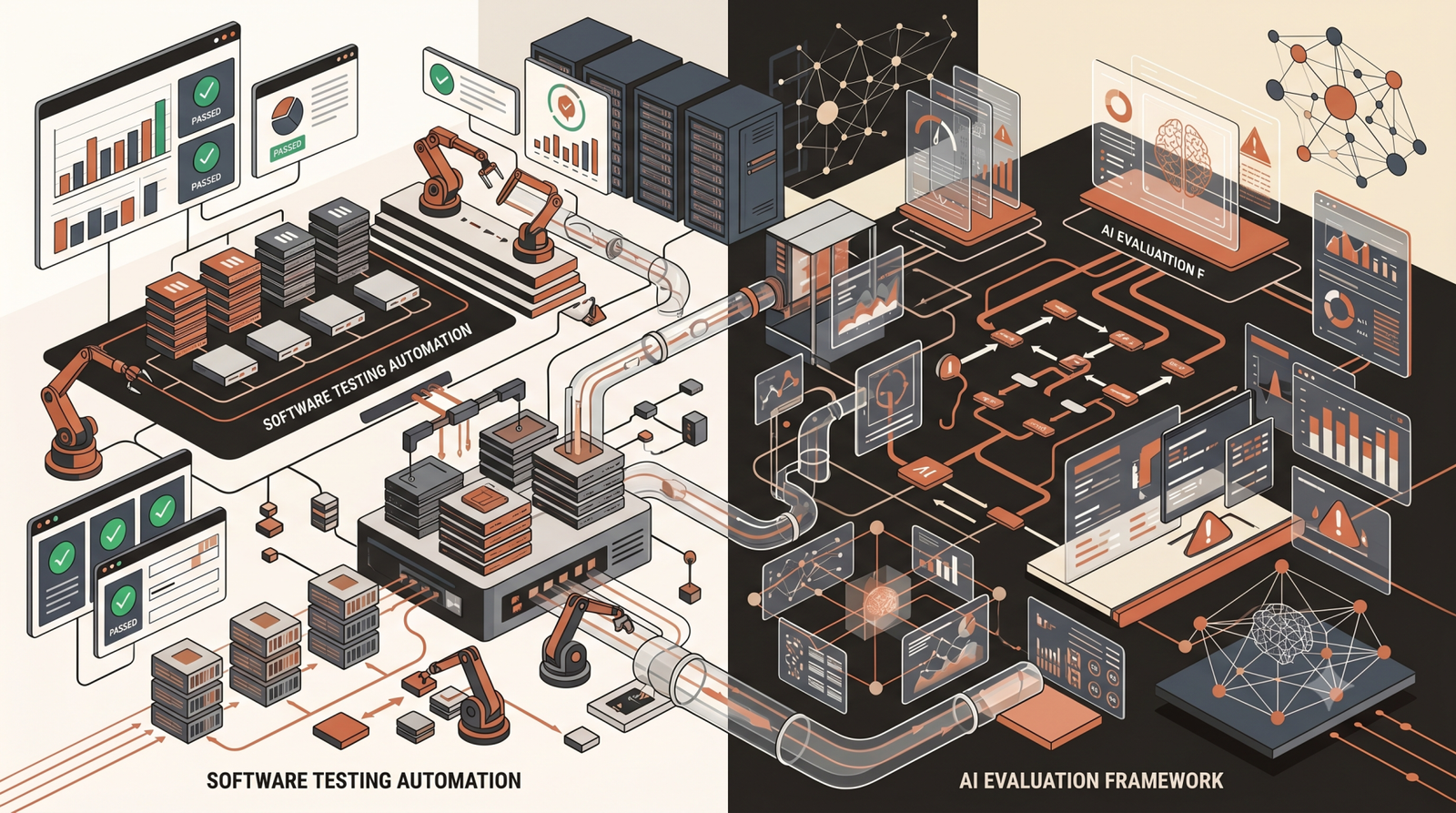
The existing Acadify Enterprise AI Evaluation Framework can serve as the deeper evaluation reference.
Observability and reliability
Production telemetry should connect a user request to model calls, retrieval operations, tool executions, latency, errors, and business outcomes.
request_total{route,status}
model_request_total{model,status}
model_latency_seconds{model}
retrieval_latency_seconds{index}
tool_errors_total{tool}
workflow_failures_total{workflow}
Use traces to correlate the workflow rather than putting complete prompts or sensitive documents into logs. Track usage separately from application metrics so cost and quality can be analyzed together.
Design for dependency failure
Model providers, vector stores, databases, queues, and third-party tools can fail independently. Use bounded timeouts, carefully selected retries, circuit breaking where appropriate, fallback behavior, and explicit degraded modes. Never retry non-idempotent writes blindly.
Scaling and cost controls
Capacity planning should consider request concurrency, model latency, context size, output size, retrieval latency, queue depth, and dependency quotas. Average traffic alone is not enough.
| Lever | Engineering effect |
|---|---|
| Model routing | Match workload complexity to appropriate serving cost |
| Caching | Reduce repeated computation and dependency load |
| Async processing | Absorb bursts and separate user latency from heavy work |
| Batching | Improve accelerator utilization for compatible workloads |
| Context controls | Limit unnecessary input and output consumption |
Optimize after measuring. A cheaper model that increases retries, support work, or failure recovery can raise total cost rather than reduce it.
Implementation roadmap
- Define the workload: document users, critical workflows, latency targets, data classes, and failure expectations.
- Establish boundaries: separate application logic, model access, data access, tools, and operational controls.
- Secure the path: implement authentication, authorization, secret management, input validation, and least privilege.
- Instrument the system: add request IDs, traces, metrics, structured logs, and audit events.
- Build evaluation: create representative datasets and regression cases tied to release decisions.
- Automate deployment: use reproducible builds, staging, smoke tests, and controlled rollout.
- Exercise failure modes: test provider outages, stale data, tool failures, timeouts, rate limits, and recovery.
- Optimize from evidence: tune routing, caching, retrieval, concurrency, and capacity using production telemetry.
Production checklist
- Application responsibilities are separated from model behavior.
- Model access is controlled through a defined interface or gateway.
- Data retrieval enforces identity, tenant, and resource permissions.
- Sources have provenance and freshness information.
- Tool calls have narrow capabilities and argument validation.
- High-impact actions have appropriate approval controls.
- Representative evaluations run before release.
- Production traces connect requests to model and tool operations.
- Timeouts, retries, quotas, and dependency failures are handled explicitly.
- Cost and capacity metrics are visible.
- Deployments are reproducible and reversible.
- Incident and recovery procedures are tested.
Frequently asked questions
What is production AI architecture?
It is the end-to-end design connecting an application to model execution, governed data, security controls, orchestration, evaluation, observability, deployment, and operational recovery.
Should the model make business decisions directly?
High-impact business rules should remain enforceable in application code or policy systems. Model output can inform a decision, but critical authorization and state transitions should have deterministic controls.
Does every application need a model gateway?
Not necessarily. A gateway becomes valuable when the product needs provider abstraction, routing, centralized policy, usage accounting, reliability controls, or multiple model backends.
How should retrieved data be secured?
Apply identity and resource permissions during retrieval so unauthorized evidence never enters the model context. Treat retrieved content as untrusted input as well.
What should be monitored in production?
Monitor application reliability, model latency and errors, retrieval quality signals, tool failures, usage, security events, and business outcomes.
Key takeaways
- The model is one component. Production quality depends on the surrounding application, data, security, and operational architecture.
- Keep control deterministic. Authorization, state transitions, and high-impact actions need enforceable application or policy controls.
- Secure retrieval before generation. Unauthorized evidence should never reach the model context.
- Evaluate and observe continuously. Release tests and production telemetry form one reliability loop.
- Design for failure and cost. Timeouts, quotas, capacity, routing, and recovery should be architectural concerns.
Conclusion
Production AI systems should be engineered as complete software platforms rather than as model integrations wrapped in an API. The model is only one component in a larger control system. Application services define business behavior, identity systems establish who can act, retrieval services determine what evidence can enter a context, tool APIs define which external effects are possible, and observability explains what happened when the system behaves unexpectedly.
This architecture creates useful change boundaries. A model provider can be replaced without changing authorization logic. A retrieval implementation can evolve without moving security policy into prompts. A tool can be upgraded without giving the model broader permissions. Deployment can be rolled back without discarding evaluation history or operational evidence.
The most important design principle is to keep high-impact control deterministic. Model output can classify, summarize, recommend, draft, or propose an action. The application or policy layer should decide whether that action is permitted, whether the required evidence is authorized, whether the request is within a defined risk threshold, and whether the resulting state transition is valid.
Teams should also treat production telemetry and evaluation as a feedback loop. Release evaluations identify known weaknesses before exposure. Runtime telemetry reveals new failure modes, latency patterns, dependency problems, data freshness issues, and unexpected user behavior. Those observations should become new regression cases, architecture improvements, or operational controls.
Finally, reliability should be designed before scale arrives. Bounded timeouts, explicit retries, idempotent writes, staged releases, capacity limits, dependency isolation, and recovery procedures are easier to establish before an application becomes business-critical. The result is not merely a more sophisticated model integration. It is a production system that can be observed, tested, secured, changed, and recovered with engineering discipline.
Glossary & Key Architecture Definitions
- • Model gateway: a controlled service boundary that routes application requests to one or more model providers or serving systems.
- • Grounding: connecting generated output to relevant, authorized evidence.
- • Tool execution: controlled invocation of external actions or services by an application workflow.
- • Production readiness: evidence that a system meets defined security, quality, reliability, operational, and release requirements.
Engineering Research & Citations
- [1] OpenTelemetry: https://opentelemetry.io/docs/
- [2] OWASP Application Security Verification Standard: https://owasp.org/www-project-application-security-verification-standard/
- [3] Kubernetes Deployments: https://kubernetes.io/docs/concepts/workloads/controllers/deployment/
- [4] NIST AI Risk Management Framework: https://www.nist.gov/itl/ai-risk-management-framework
No perspectives submitted yet. Be the first to start the discussion.