
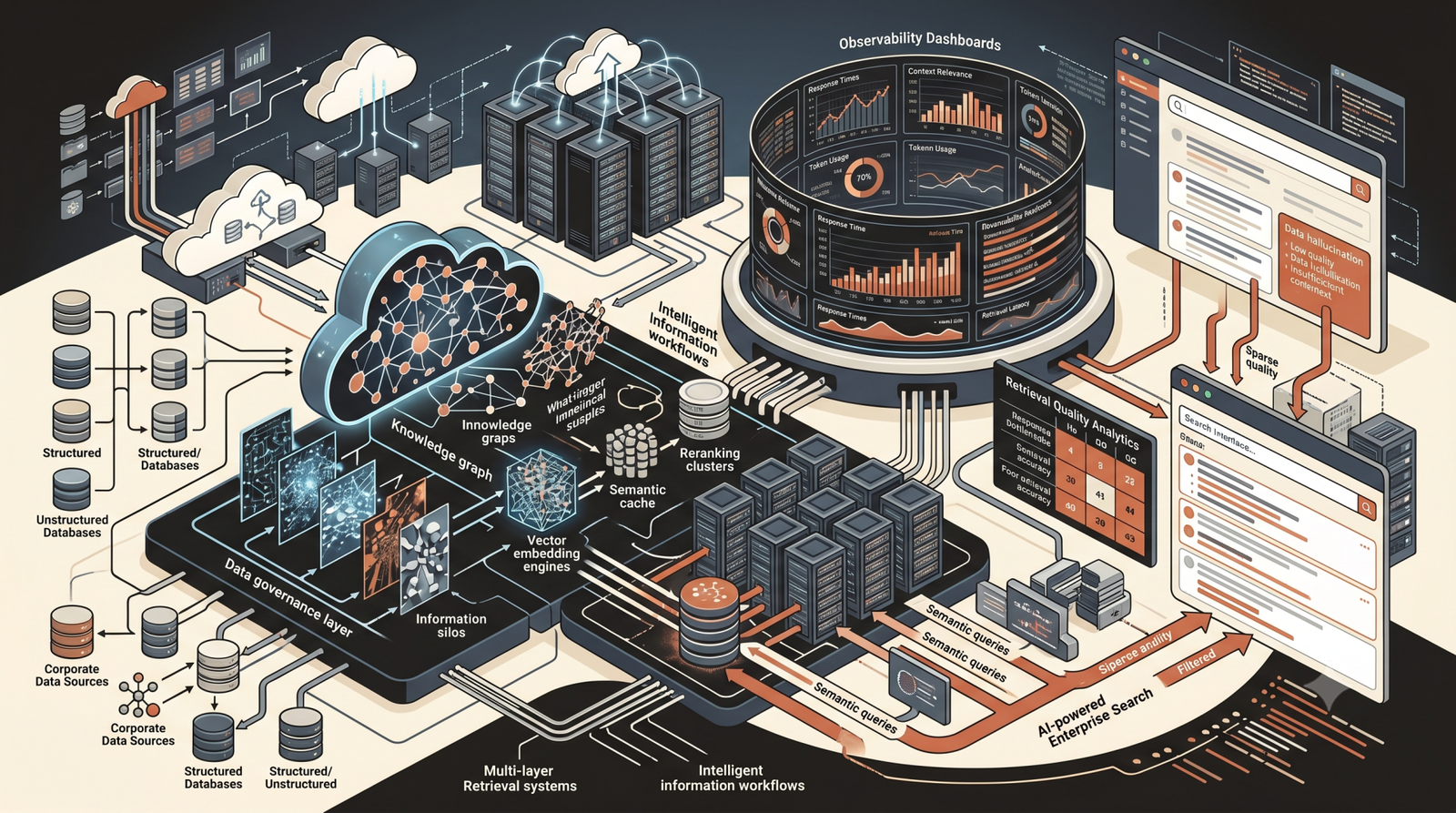
The Enterprise RAG Gold Rush
Retrieval-Augmented Generation has become the default architecture for enterprise AI initiatives.
Executives see demonstrations where AI assistants instantly answer complex questions from internal documents, compliance manuals, contracts, support tickets, and operational knowledge bases.
The promise appears compelling.
Need MVP Development or AI Solutions?
Turn your idea into reality with Acadify. Fast, scalable, and built for enterprise growth.
Instead of retraining models, organizations can connect existing knowledge repositories to large language models and deliver contextual intelligence across the business.
Yet an uncomfortable reality is emerging across enterprises.
Many RAG implementations successfully complete proof-of-concept phases but struggle to generate measurable business outcomes after deployment.
The challenge is not that RAG does not work.
The challenge is that most organizations underestimate the complexity of building reliable knowledge systems at enterprise scale.
The Real Problem Is Not Retrieval
Most teams assume the primary challenge is connecting a vector database to a language model.
That assumption creates expensive mistakes.
The technical implementation of retrieval is often the simplest part of the project.
The difficult problems emerge from:
- Knowledge quality
- Document governance
- Access control management
- Retrieval relevance
- Data freshness
- Evaluation infrastructure
- Operational monitoring
Organizations frequently discover that poor knowledge management becomes visible once AI systems begin interacting with enterprise content.
The Data Quality Crisis Hidden Inside Most Enterprises
Enterprise knowledge rarely exists in a clean, centralized format.
Information is typically distributed across:
- Confluence workspaces
- SharePoint repositories
- Google Drive folders
- CRM systems
- Support platforms
- Emails
- Internal wikis
- Legacy databases
Over time, these systems accumulate duplicate information, outdated documentation, conflicting policies, and inconsistent formats.
When RAG systems retrieve inaccurate or outdated content, response quality declines regardless of model capability.
Many organizations incorrectly blame the model when the underlying problem originates in knowledge governance.
Why Vector Databases Alone Do Not Solve Enterprise Search
A common misconception is that implementing PGVector, Pinecone, Weaviate, or another vector platform automatically creates intelligent retrieval.
In practice, retrieval quality depends on multiple architectural decisions.
Successful systems typically require:
- Metadata enrichment
- Chunking optimization
- Hybrid search strategies
- Semantic ranking
- Access-aware retrieval
- Context compression
- Relevance scoring
The organizations achieving the strongest results treat retrieval as a continuously optimized system rather than a one-time implementation task.
The Missing Evaluation Layer
One of the biggest reasons enterprise RAG projects fail is the absence of structured evaluation.
Many teams evaluate systems through occasional manual testing.
This approach becomes unsustainable as knowledge bases grow.
Production-grade RAG systems require automated evaluation frameworks capable of measuring:
- Groundedness
- Answer accuracy
- Retrieval relevance
- Context utilization
- Citation quality
- Hallucination frequency
- Response consistency
Without evaluation infrastructure, organizations cannot reliably measure improvement or detect performance degradation.
Governance Becomes a Competitive Advantage
As enterprise AI adoption accelerates, governance is becoming a critical differentiator.
Successful RAG deployments implement:
- Role-based access controls
- Knowledge ownership models
- Audit logging
- Data classification frameworks
- Document lifecycle management
- Compliance monitoring
Governance is not merely a compliance requirement.
It directly influences answer quality, trustworthiness, and business adoption.
The Architecture Behind High-Performing Enterprise RAG Systems
The most successful implementations typically combine multiple layers of infrastructure.
These environments often include:
- Next.js enterprise portals
- NestJS service layers
- PostgreSQL operational databases
- PGVector retrieval infrastructure
- Redis caching systems
- Document processing pipelines
- Evaluation frameworks
- Observability platforms
- Workflow orchestration engines
Organizations that invest in architectural maturity consistently outperform teams focused solely on model selection.
The ROI Measurement Problem
Many enterprises struggle to quantify RAG success.
Executives often measure activity instead of outcomes.
Meaningful ROI indicators include:
- Support ticket reduction
- Knowledge retrieval speed
- Employee productivity gains
- Training cost reductions
- Compliance efficiency improvements
- Decision-making acceleration
Successful deployments tie technical performance metrics directly to business outcomes.
A Practical Framework for Enterprise Success
Organizations planning RAG initiatives should prioritize five areas.
- Knowledge Quality
- Retrieval Optimization
- Evaluation Infrastructure
- Governance Controls
- Operational Monitoring
Weakness in any of these areas can significantly reduce deployment effectiveness.
RAG should be viewed as an operational capability rather than a standalone AI feature.
Strategic Recommendations for CTOs
Before investing in enterprise RAG systems, leadership teams should assess the maturity of their knowledge infrastructure.
Organizations with fragmented documentation, weak governance, and limited observability often struggle to achieve expected outcomes.
The highest-performing deployments begin with knowledge architecture improvements before AI implementation begins.
This sequence dramatically increases adoption rates and long-term ROI.
Conclusion
The future of enterprise AI will not be determined by model size alone.
It will be determined by how effectively organizations manage, retrieve, validate, and govern knowledge.
RAG systems represent one of the most practical paths to enterprise AI adoption, but success requires much more than connecting a vector database to a language model.
Organizations that invest in retrieval quality, governance, evaluation, and operational excellence will generate measurable business value while competitors remain trapped in proof-of-concept cycles.
No perspectives submitted yet. Be the first to start the discussion.