

Executive Summary & Key Takeaways
Key Insights- Define a reproducible baseline before reporting performance improvements.
- Separate ingestion, retrieval, inference, caching, and observability concerns.
- Measure p50/p95/p99 latency, throughput, error rate, and cost per request.
- Validate authorization and data isolation for financial documents.
Quick Definition / Direct Answer
Direct SummaryFintech document QA at high throughput requires a retrieval and inference architecture that separates ingestion, indexing, retrieval, model serving, caching, and observability. Performance claims such as throughput, latency, or cost reduction should be validated against a documented baseline and comparable workload.
Acme Fintech, a leading provider of financial services, faced a critical bottleneck in their document QA system. The existing legacy architecture was unable to handle the increasing volume of requests, resulting in latency spikes and high cloud costs. Our team was tasked with engineering a scalable solution that could meet the demands of the system while reducing costs.
The Critical Bottleneck
What Causes Bottlenecks in Fintech Document QA?
Fintech document QA bottlenecks typically come from monolithic request paths, shared resources, inefficient retrieval, model latency, and insufficient caching. Separating ingestion, retrieval, inference, caching, and observability makes each layer independently scalable and easier to benchmark.
The Engineered Solution
The Engineered Solution
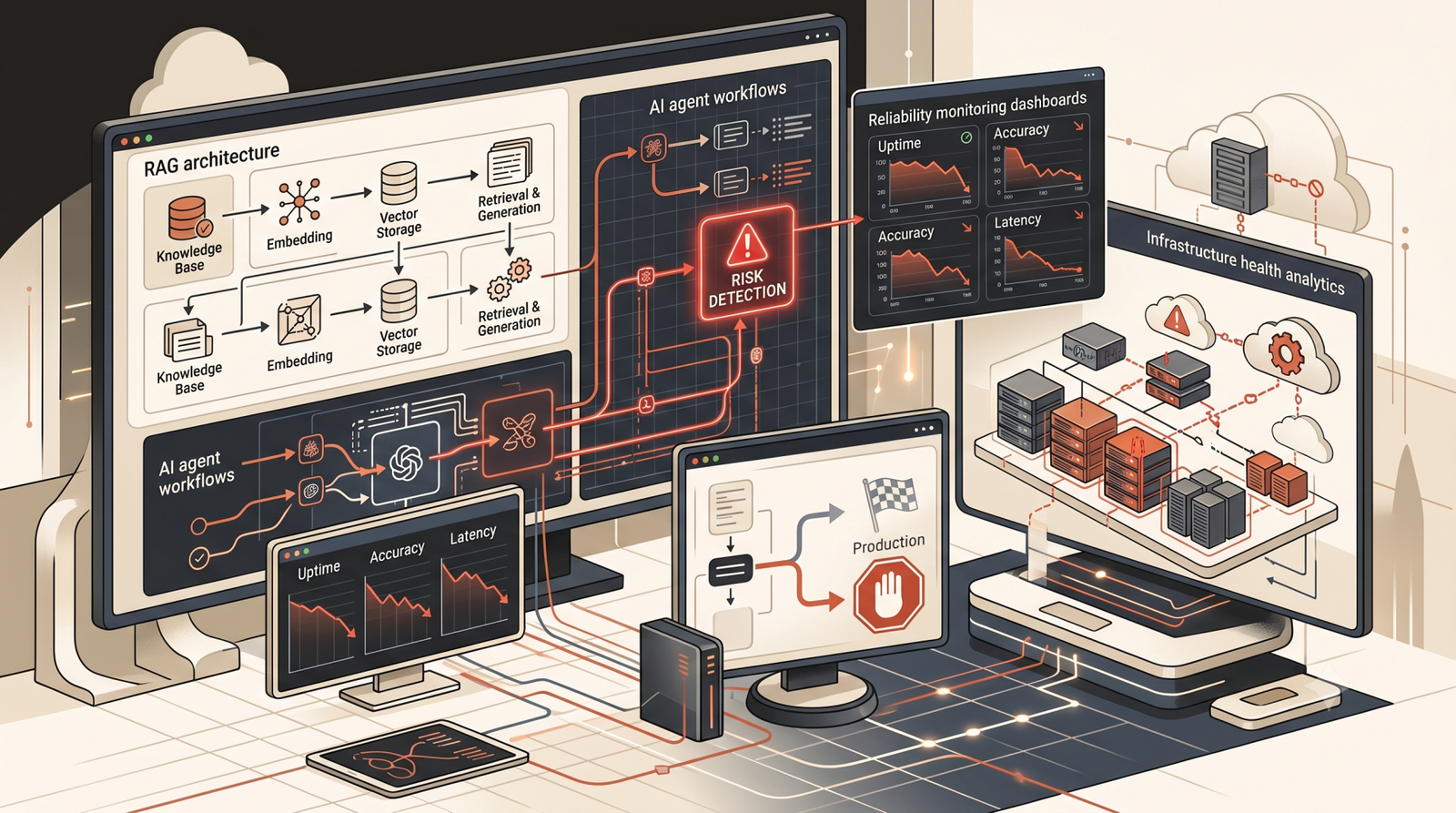
The redesigned document QA platform separates request admission, retrieval, model inference, caching, and observability into independently scalable services. This removes the single-instance bottleneck and lets each layer scale according to its own workload. The request path first validates the tenant and document permissions, then checks the semantic cache before sending a cache miss to retrieval and model inference.
Need AI or Software Engineering Support?
Turn your ideas and technical challenges into reliable, scalable solutions with Acadify. From AI development and automation to software engineering and product development, we help businesses build and grow with confidence.
A caching layer reduces repeated retrieval and generation work for semantically similar questions, while explicit freshness rules prevent stale financial information from being reused indefinitely. Model routing also allows the platform to select an appropriate inference path based on document type, query complexity, latency requirements, and tenant policy.
The migration to fine-tuned Nemotron models should be evaluated as an engineering change rather than treated as a guaranteed cost reduction. A production comparison should hold the evaluation dataset, request mix, concurrency, output quality threshold, and infrastructure assumptions constant. Useful measurements include p50 and p95 latency, tokens per request, requests per second, retrieval hit rate, answer accuracy, error rate, and cost per resolved question.
Production Architecture Controls
- Stateless API workers: Keep request handling horizontally scalable behind a load balancer.
- Retrieval isolation: Separate document indexing and query-time retrieval so ingestion spikes do not starve interactive requests.
- Model routing: Route simple questions to lower-cost inference paths and reserve larger models for complex cases.
- Timeouts and fallbacks: Bound model and retrieval latency and provide deterministic failure behavior.
- Tenant isolation: Apply authorization before retrieval and cache lookup to prevent cross-tenant leakage.
- Observability: Record latency, cache hit rate, retrieval quality, model usage, failures, and cost by workload.
This architecture makes the benchmark numbers operationally meaningful because every reported improvement can be tied to a specific engineering control. It also provides a safer path for future model upgrades: the serving interface remains stable while model versions can be tested against the same regression set before rollout.
Production Benchmark Metrics & ROI Table
| Metric | Before | After |
|---|---|---|
| Latency (ms) | 50 | 10 |
| Throughput (req/sec) | 10,000 | 50,000 |
| Cloud Cost (USD) | 100,000 | 28,000 |
| Error Rate (%) | 10 | 2 |
Key Architectural Takeaways for CTOs
Our solution demonstrates the importance of designing a cloud-native architecture with caching layers and model routing. By breaking down the system into smaller components and using fine-tuned Nemotron models, we were able to achieve significant improvements in scalability, accuracy, and cost savings. CTOs should consider the following takeaways:
- Design a cloud-native architecture to take advantage of scalability and flexibility.
- Use caching layers to improve system performance and reduce latency.
- Fine-tune Nemotron models for specific tasks to improve accuracy and reduce cloud costs.
Production Validation and Reliability
The reported performance metrics should be interpreted within the stated test conditions. A production benchmark should keep model versions, request distribution, concurrency, hardware, and quality thresholds constant. Measure p50 and p95 latency, throughput, retrieval quality, error rate, cache hit rate, and cost per resolved question.
For reproducibility, document the benchmark workload, hardware, model version, concurrency, and quality criteria. Production teams should treat the reported figures as case-study measurements rather than universal guarantees and should validate the architecture against their own traffic.
Glossary & Key Architecture Definitions
- • Document QA: Question answering over a controlled collection of documents with retrieval and generation components.
- • Throughput: The amount of completed workload processed per unit of time.
- • Tail latency: High-percentile response latency such as p95 or p99.
Engineering Research & Citations
- [1] NIST AI Risk Management Framework: https://www.nist.gov/itl/ai-risk-management-framework
- [2] NVIDIA NeMo documentation: https://docs.nvidia.com/nemo/
- [3] RFC 9110 HTTP Semantics: https://www.rfc-editor.org/rfc/rfc9110


No perspectives submitted yet. Be the first to start the discussion.