
Executive Summary & Key Takeaways
• Understand the Enterprise AI Maturity Model
• Identify your current AI level and roadmap for growth
• Learn from AI leaders and accelerate your digital transformation
• Identify your current AI level and roadmap for growth
• Learn from AI leaders and accelerate your digital transformation
1. Overview
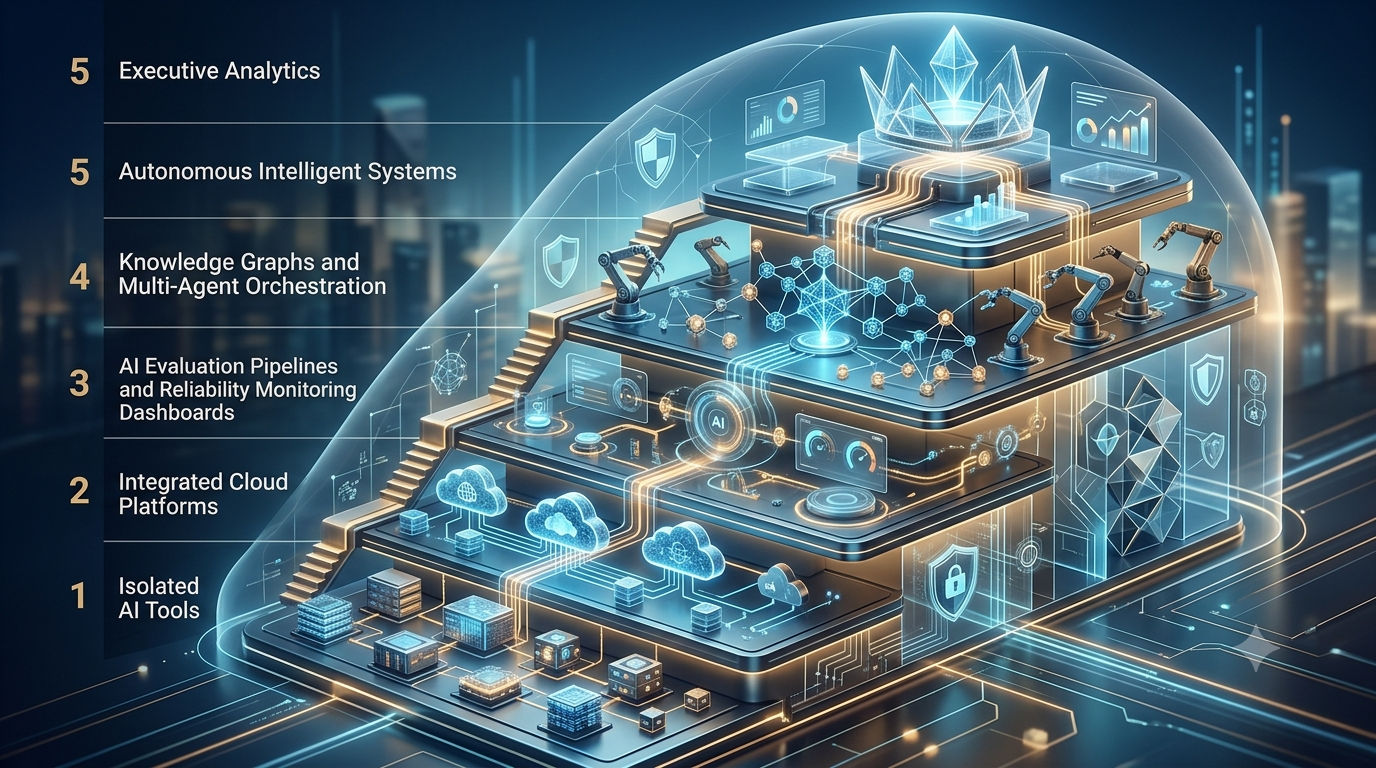
As the second decade of Enterprise AI unfolds, organizations are struggling to bridge the gap between AI experimentation and measurable competitive advantages. The key to success lies in understanding the nuances of AI maturity and adopting a structured approach to its implementation. In this article, we will delve into the Enterprise AI Maturity Model, a five-stage framework that helps organizations navigate the complexities of AI adoption and unlock its full potential for business transformation.
Benchmark Analysis
| Level | Description | Characteristics |
|---|---|---|
| Level 1 - AI Experimentation | Most companies currently operate at this level, using public AI tools for content creation, coding assistance, and document summarization. | Isolated AI usage, No governance, No evaluation framework, No shared AI strategy, Limited business impact |
| Level 2 - AI-Enhanced Workflows | Organizations begin integrating AI into existing business processes, reducing operational effort but still relying on human-led decisions. | AI usage in specific business processes, Integration quality is key, Model capability is secondary |
| Level 3 - AI as Operational Infrastructure | AI becomes a reusable capability, treated like databases, APIs, and cloud platforms, powering multiple business systems. | Prompt management, Evaluation pipelines, AI testing frameworks, Model routing, Observability, Governance controls, Knowledge infrastructure |
| Level 4 - Autonomous Business Operations | Organizations deploy AI agents capable of executing well-defined workflows under controlled governance. | Procurement automation, Software delivery orchestration, Financial reconciliation, Compliance monitoring, Customer onboarding, Technical support resolution |
| Level 5 - AI-Driven Business Strategy | Leaders build systems that integrate AI into every aspect of business operations, decision-making, and execution. | AI-driven business strategy, Integrated AI decision-making, Real-time AI-driven execution, Continuous AI improvement |
Implementation Snippet
# Production implementation
import os
from typing import Dict, List

# Define the AI maturity model levels
class AIMaturityModel:
    def __init__(self):
        self.levels = {
            'Level 1': {
                'description': 'AI Experimentation',
                'characteristics': ['Isolated AI usage', 'No governance', 'No evaluation framework', 'No shared AI strategy', 'Limited business impact']
            },
            'Level 2': {
                'description': 'AI-Enhanced Workflows',
                'characteristics': ['AI usage in specific business processes', 'Integration quality is key', 'Model capability is secondary']
            },
            'Level 3': {
                'description': 'AI as Operational Infrastructure',
                'characteristics': ['Prompt management', 'Evaluation pipelines', 'AI testing frameworks', 'Model routing', 'Observability', 'Governance controls', 'Knowledge infrastructure']
            },
            'Level 4': {
                'description': 'Autonomous Business Operations',
                'characteristics': ['Procurement automation', 'Software delivery orchestration', 'Financial reconciliation', 'Compliance monitoring', 'Customer onboarding', 'Technical support resolution']
            },
            'Level 5': {
                'description': 'AI-Driven Business Strategy',
                'characteristics': ['AI-driven business strategy', 'Integrated AI decision-making', 'Real-time AI-driven execution', 'Continuous AI improvement']
            }
        }

    def get_level(self, level: str) -> Dict:
        return self.levels.get(level)

# Example usage
model = AIMaturityModel()
level = model.get_level('Level 3')
print(f
No perspectives submitted yet. Be the first to start the discussion.