

Executive Summary & Key Takeaways
Key Insights- Treat model, prompt, retrieval, tool, policy, routing, and application changes as potential behavioral changes.
- Combine deterministic contracts with behavioral, safety, security, and operational gates.
- Use staged deployment to limit exposure while collecting production evidence.
- Version the full behavioral change surface so rollback restores a known-good configuration.
- Turn meaningful production incidents into regression tests and continuously strengthen the evaluation set.
Quick Definition / Direct Answer
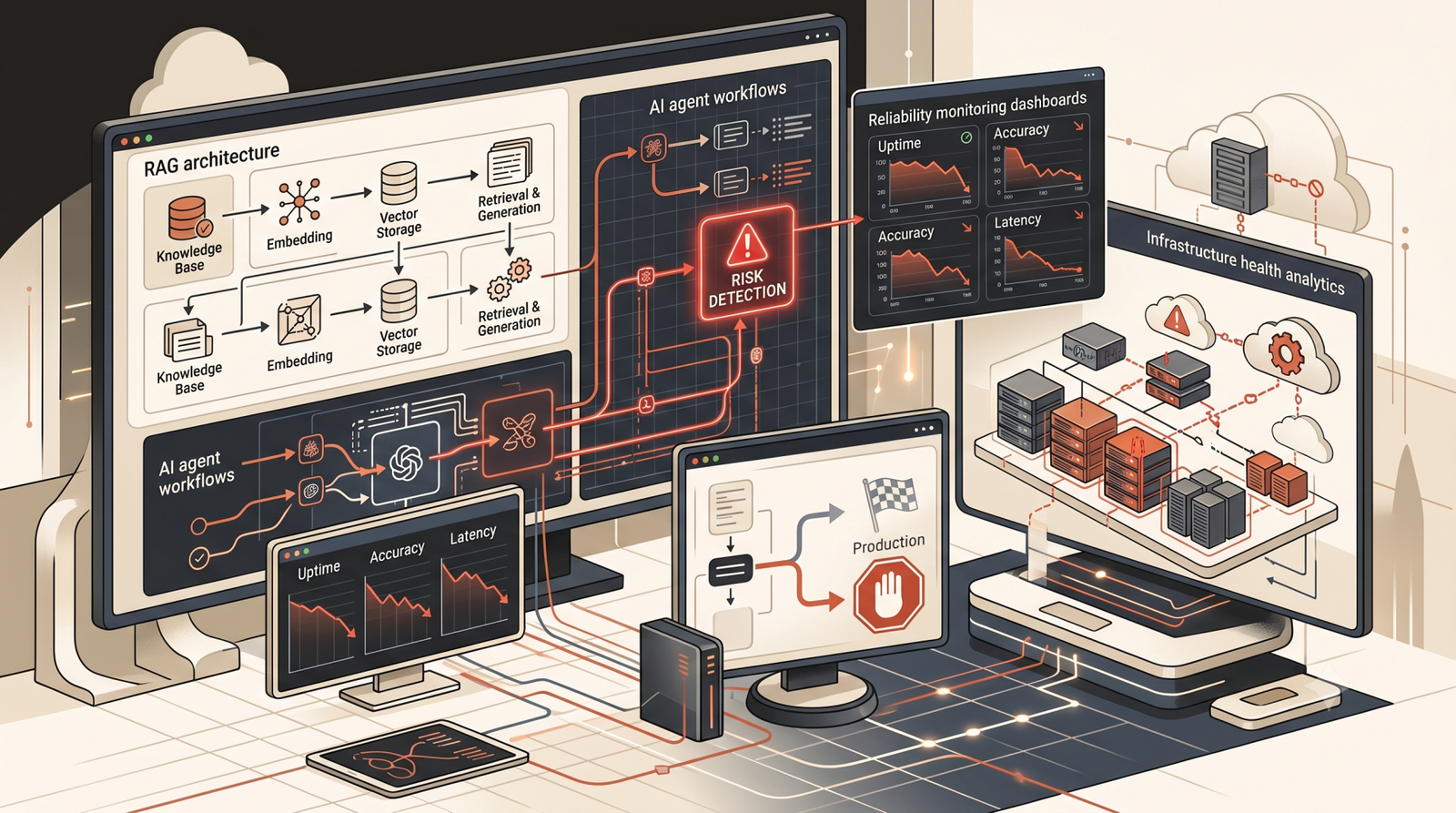
Direct SummaryAI release engineering connects evaluation, quality gates, staged deployment, production observability, incident response, and rollback so teams can make release decisions with evidence and recover when real-world behavior differs from expectations.
Production AI needs more than a benchmark score. A release can change a model, prompt, retrieval setup, tool schema, safety policy, routing rule, or application code. Each change can alter behavior in ways that ordinary software tests may not reveal.
AI release engineering turns those risks into an explicit delivery process. The objective is to verify what changed, evaluate the behavior that matters, control production exposure, observe real execution, and recover quickly when a release does not meet its requirements.
This approach connects pre-release evaluation with production operations. NIST's March 2026 research notes that pre-deployment evaluations are generally performed in controlled environments, while post-deployment monitoring is needed to validate real-world behavior and identify unforeseen outputs. NIST's report on deployed AI monitoring also identifies unresolved questions around monitoring methods, cadence, drift, distributed logging, and human-AI feedback loops.
Need AI or Software Engineering Support?
Turn your ideas and technical challenges into reliable, scalable solutions with Acadify. From AI development and automation to software engineering and product development, we help businesses build and grow with confidence.
Direct answer: AI release engineering is the practice of connecting evaluation, quality gates, staged deployment, production observability, incident response, and rollback so teams can make release decisions with evidence and recover when real-world behavior differs from expectations.
Why AI Releases Need a Different Control Layer
Traditional software releases usually center on a versioned application artifact. Intelligent applications have a wider behavioral change surface.
A production response can be influenced by:
- The model and serving configuration
- System and developer instructions
- Retrieved context and ranking logic
- Tool definitions and permissions
- Safety and policy controls
- Routing and fallback rules
- Application code
- Runtime configuration and feature flags
- External services and changing data
That means a release pipeline should ask more than “did the build pass?” It should ask whether the proposed change can alter a behavior that matters to users, the business, or the risk profile of the system.
NIST's 2026 TEVV-Athlon work reinforces this context-specific approach. Its proposed framework is designed to be adaptable across different AI applications, including language models, multimodal systems, and agentic systems. The evaluation method therefore needs to reflect the application and its requirements rather than rely on one universal score. NIST's TEVV-Athlon framework
What Should Trigger a Release Evaluation?
Do not make model upgrades the only evaluation trigger. Any change with meaningful behavioral impact should be considered for validation.
| Change | Possible effect | Validation to consider |
|---|---|---|
| Model version | Different answers, latency, refusals, or tool choices | Regression and task evaluations |
| Prompt or instructions | Different instruction following or output format | Behavioral regression tests |
| Retrieval configuration | Different context quality or source coverage | Retrieval and groundedness checks |
| Tool schema or permissions | Different actions or arguments | Tool-use and authorization tests |
| Safety policy | Different handling of sensitive requests | Safety and adversarial testing |
| Routing logic | Different models or workflows receive requests | Route and end-to-end tests |
| Post-processing | Changed filtering or output transformation | Contract and end-to-end tests |
The practical rule is simple: trigger evaluation based on behavioral impact, not on which repository file changed.
The Five-Layer AI Release Control Model
A useful release process can be organized into five layers: Verify, Evaluate, Protect, Observe, and Recover. Together they create a control loop instead of a single pre-production checkpoint.
1. Verify the application contract
Start with deterministic checks wherever possible. Validate schemas, required fields, authorization boundaries, tool arguments, API contracts, and other conditions that should be binary.
These checks are valuable because they do not require subjective grading. If a tool must receive a particular argument type, the release pipeline should be able to reject an invalid request directly.
2. Evaluate behavior
Run representative tasks against a curated evaluation set. Compare the candidate against a known baseline and inspect important failure categories rather than relying only on an aggregate score.
Anthropic's January 2026 guidance describes evaluations as a way to make behavioral changes visible before they affect users. It also notes that agent evaluation becomes more complex when systems use tools, state, and multiple turns. Anthropic's guide to evaluating AI agents
3. Protect against high-impact failures
Functional quality is not enough if a release creates a security or safety regression. Depending on the application, checks may cover prompt injection, sensitive-data handling, authorization, unsafe tool execution, policy adherence, and isolation between trust boundaries.
NIST's Generative AI Profile provides additional risk-management considerations for generative systems and can help teams map release controls to the risks relevant to their application. NIST's Generative AI Profile
4. Observe production behavior
Before increasing traffic, verify that the telemetry required to detect failures is actually available. Monitoring should cover both system health and application behavior.
5. Recover when evidence says to stop
A release process is incomplete if a team can detect a problem but cannot safely return to a known-good configuration. Recovery should be designed before deployment, not improvised during an incident.
How to Design Effective Quality Gates
A quality gate is a predefined condition that a release must satisfy before progressing. Use several gates because different tests answer different questions.
Contract gates
Use deterministic checks for JSON validity, schemas, required fields, authorization, tool arguments, API contracts, and application invariants.
Behavioral gates
Use representative tasks to test instruction following, groundedness, task completion, output quality, refusal behavior, and other product-specific requirements.
For agents, evaluate more than the final response. Tool selection, tool arguments, intermediate state changes, and final outcomes may all matter. Anthropic describes task-based evaluations, trials, graders, and complete execution traces as useful building blocks for agent evaluation. Anthropic agent evaluation research
Security and safety gates
Test the failure modes that could create meaningful harm. Examples include unauthorized actions, prompt injection, data leakage, policy violations, and unsafe tool execution.
Operational gates
Confirm that the candidate meets the service requirements for latency, error rates, capacity, timeout behavior, fallbacks, and resource consumption.
Do not create a universal threshold table for every product. A latency target for a batch research workflow may be inappropriate for a real-time customer interaction. Release criteria should come from the system's requirements and risk tolerance.
Why Canary Deployment Matters
A canary release exposes a new version to a controlled portion of traffic before a wider rollout. Its purpose is not to guarantee safety. Its purpose is to reduce exposure while additional evidence is collected.
Client Request
      |
      v
Traffic Router
   /       \
  /         \
Stable     Candidate
  |           |
  v           v
Model +     Model +
Tools       Tools
  |           |
  +-----+-----+
        |
        v
Telemetry + Evaluation
        |
        v
Rollout Controller
The rollout controller should use the release criteria defined before deployment. If the candidate produces a critical regression, the system should be able to pause traffic, investigate, or return traffic to the stable version.
This approach is especially useful because offline evaluation cannot reproduce every production condition. NIST's deployed-system monitoring research highlights dynamic inputs, nondeterminism, drift, distributed logging challenges, and other issues that make real-world monitoring a necessary complement to controlled testing. NIST's 2026 monitoring findings
What Should Be Versioned for Rollback?
Rollback should restore the configuration that produced the last known-good behavior. Reverting only a model may not be enough if the prompt, retrieval layer, tool schema, or routing logic also changed.
Depending on the architecture, version:
- Model identifier and serving configuration
- Prompt and instruction templates
- Retrieval configuration and ranking parameters
- Tool definitions and schemas
- Safety policies and routing rules
- Application code
- Feature flags and relevant runtime configuration
This leads to an important engineering principle:
The rollback unit should match the behavioral change surface.
Rollback conditions should also be explicit. Examples can include a critical contract failure, confirmed security regression, unacceptable tool-execution error, or validated degradation in an important evaluation slice. The exact threshold belongs to the application's requirements.
How Observability Completes the Release Loop
Evaluation and observability answer different questions.
Evaluation asks: Does the candidate behave acceptably on selected tests?
Observability asks: What is happening during actual execution?
A useful telemetry model connects:
- Request metadata
- Model and prompt version
- Retrieval statistics or source identifiers
- Tool calls and outcomes
- Latency and resource consumption
- Guardrail and policy events
- Response metadata
- User feedback or downstream outcomes where available
NIST's 2026 monitoring research groups post-deployment monitoring into categories including functionality and operational monitoring and identifies open questions around monitoring cadence, automation versus human validation, and detection of degradation. NIST monitoring research
For engineering teams, the practical goal is traceability. When a response is wrong, the telemetry should help determine whether the problem originated in retrieval, generation, tool use, policy, infrastructure, or another component.
How Production Incidents Should Improve Testing
A meaningful production incident should not end when the immediate defect is fixed. It should improve the release process.
- Detect: identify the anomaly through monitoring, user feedback, or an operational alert.
- Reproduce: isolate the input, configuration, and execution path.
- Classify: determine the failing component and risk category.
- Fix: change the smallest component that addresses the cause.
- Evaluate: confirm that the fix works and check for regressions.
- Preserve: add the incident to the regression set when it represents a reusable risk.
Anthropic's current evaluation guidance recommends building evaluation tasks from real failures and user-facing problems. It also describes production monitoring, A/B testing, user feedback, and automated evaluations as complementary signals rather than replacements for one another. Anthropic's evaluation guidance
The result is a learning loop:
Production Incident
       |
       v
    Reproduce
       |
       v
      Fix
       |
       v
Regression Test
       |
       v
Release Gate
       |
       v
Future Protection
Which Metrics Should Teams Track?
Metrics should map to system requirements. A large dashboard is not automatically a useful one.
| Layer | Example signals | Question |
|---|---|---|
| Application | Task completion, success, escalation | Did the workflow achieve its intended outcome? |
| Model behavior | Evaluation results, refusals, format compliance | Did behavior change materially? |
| Retrieval | Coverage, ranking signals, groundedness | Did the system obtain useful evidence? |
| Tools | Selection errors, argument validation, execution failures | Did external actions remain within requirements? |
| Operations | Latency, errors, timeouts, availability | Can the service meet its operational target? |
| Risk | Policy events, data incidents, security findings | Did the release introduce new exposure? |
Avoid hiding critical failure categories inside a single composite score. An acceptable average can coexist with a serious regression in a small but important traffic segment.
How to Build an Evaluation Set That Improves Over Time
An evaluation set should represent the behaviors that matter to the product, not simply contain a large number of arbitrary prompts.
Start with the tasks engineers already test manually. Then add cases from support tickets, production incidents, security testing, user research, and known edge cases.
Anthropic recommends starting with a small set of realistic tasks rather than waiting until a large benchmark is available. It also emphasizes clear task definitions and unambiguous grading criteria. Anthropic's evaluation methodology
For higher-risk workflows, combine different evaluation methods. NIST's September 2026 ARIA Evaluation Planning Manual describes a holistic approach that combines model testing, red teaming, and user testing. NIST's ARIA Evaluation Planning Manual
The important design principle is coverage, not volume. A small test set that represents critical failure modes can be more useful than a large collection of weak or ambiguous cases.
Production AI Release Checklist
- Identify every component that can change behavior.
- Classify the risk of the proposed change.
- Run deterministic contract checks.
- Run representative behavioral evaluations.
- Include security and safety tests relevant to the application.
- Compare the candidate with a known baseline.
- Verify production telemetry before increasing traffic.
- Use staged deployment when risk and architecture justify it.
- Define rollback conditions before deployment.
- Keep the previous known-good configuration recoverable.
- Monitor both operational and behavioral signals.
- Turn meaningful incidents into regression cases.
- Review and maintain the evaluation set as the product changes.
When Should Teams Formalize Release Engineering?
A prototype does not need a large release-control platform. The need grows when system behavior affects customers, transactions, sensitive data, operational decisions, or other high-impact workflows.
A practical maturity path is:
- Foundation: deterministic tests plus a small representative evaluation set.
- Controlled releases: version prompts and model configuration and establish baseline comparisons.
- Production controls: add staged deployment, observability, explicit release gates, and rollback procedures.
- Continuous improvement: connect incidents, user feedback, evaluation results, and release decisions.
The goal is not to make delivery slower. The goal is to make the decision to ship observable, repeatable, and reversible.
Release Engineering FAQ
What is AI release engineering?
It is the practice of connecting evaluation, quality gates, staged deployment, monitoring, incident response, and rollback for systems whose behavior can change across models, prompts, tools, data, and runtime conditions.
Are LLM evaluations enough for production readiness?
No. Evaluations cover selected behaviors. Production readiness also requires operational monitoring, security controls, deployment safeguards, and a recovery path for failures outside the test set.
When should a release be rolled back?
Rollback should occur when predefined criteria show that a candidate violates a critical functional, security, safety, or operational requirement and the problem cannot be safely contained.
What should be versioned for rollback?
Track the model and application version. Depending on the architecture, also version prompts, retrieval settings, tool schemas, policies, routing logic, feature flags, and other configuration that materially affects behavior.
How is observability different from evaluation?
Evaluation measures selected test cases. Observability provides evidence about actual execution. Evaluation helps detect known regressions before release, while observability helps detect and diagnose unexpected production behavior.
How can production incidents improve future releases?
Reproduce the incident, classify the cause, fix it, and preserve the case as a regression test when it represents a reusable risk. Over time, the evaluation set becomes more representative of real failure modes.
Need help designing an AI release-control process? Acadify Solution works with engineering teams on AI testing, evaluation, reliability, production readiness, and quality controls.
Glossary & Key Architecture Definitions
- • AI Release Engineering: The practice of connecting evaluation, deployment controls, observability, incident response, and recovery for AI-enabled systems.
- • Quality Gate: A predefined condition a release must satisfy before it progresses.
- • Canary Deployment: A staged release that exposes a candidate to a controlled portion of traffic before wider rollout.
- • Rollback: Returning an application to a previously known-good configuration after a release failure.
- • AI Observability: Telemetry and tracing used to understand system execution, dependencies, failures, and operational behavior.
- • TEVV: Test, Evaluation, Verification, and Validation.
Engineering Research & Citations
- [1] NIST, Challenges to the Monitoring of Deployed AI Systems, March 2026. https://www.nist.gov/publications/challenges-monitoring-deployed-ai-systems-center-ai-standards-and-innovation
- [2] NIST, The TEVV-Athlon Framework for Evaluating AI Systems, 2026. https://www.nist.gov/artificial-intelligence/ai-research/tevv-athlon-framework-evaluating-ai-systems
- [3] NIST, ARIA Evaluation Planning Manual: Elements of ARIA-Style AI Evaluations, September 2026. https://www.nist.gov/publications/aria-evaluation-planning-manual-elements-aria-style-ai-evaluations
- [4] NIST, Artificial Intelligence Risk Management Framework: Generative Artificial Intelligence Profile, 2024. https://www.nist.gov/publications/artificial-intelligence-risk-management-framework-generative-artificial-intelligence
- [5] Anthropic, Demystifying evals for AI agents, January 2026. https://www.anthropic.com/engineering/demystifying-evals-for-ai-agents


No perspectives submitted yet. Be the first to start the discussion.