
Executive Summary & Key Takeaways
• AI testing is often overlooked and under-resourced
• Improving AI testing can lead to better business outcomes
1. Overview
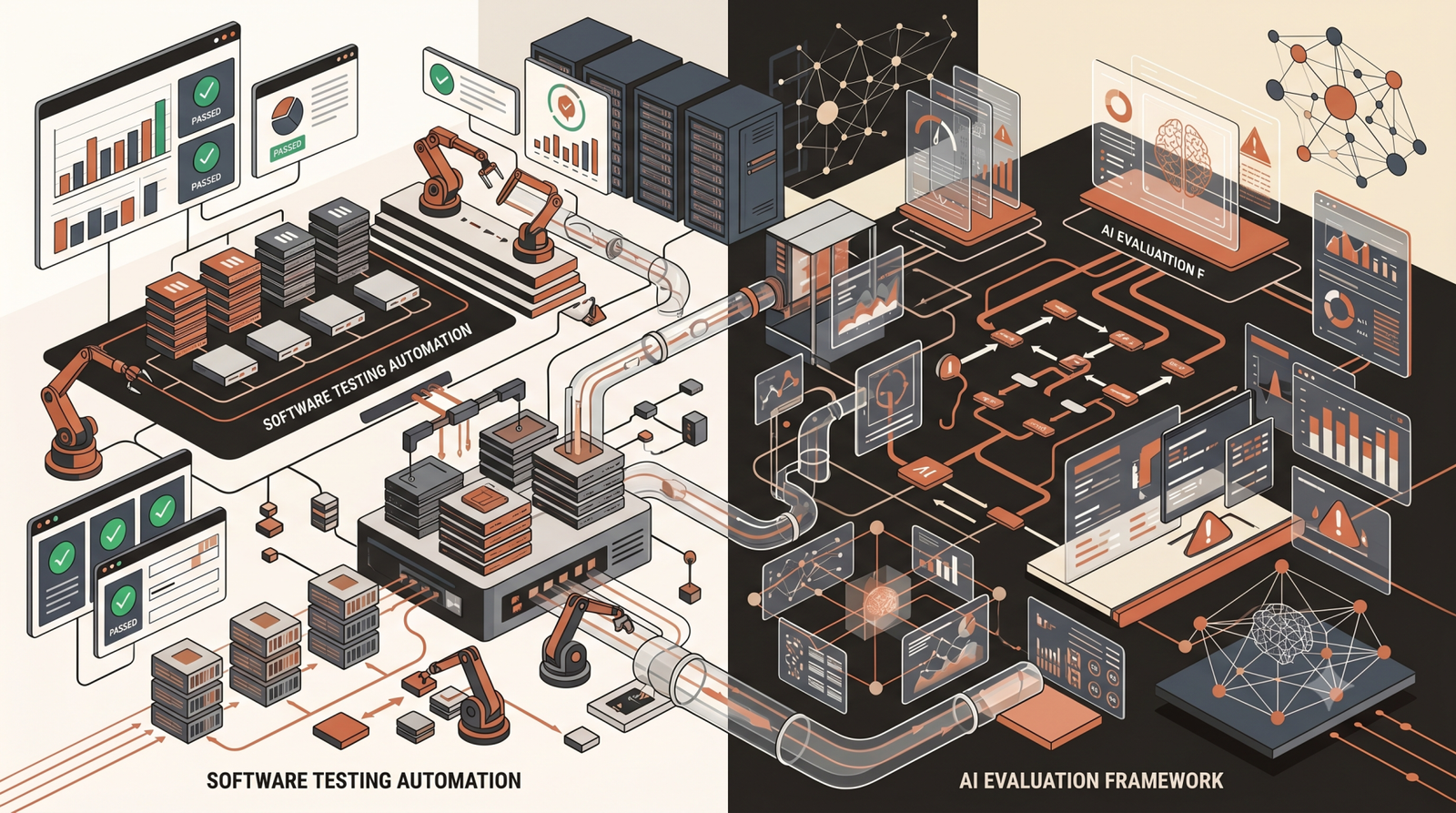
Deep technical insight into the AI evaluation gap reveals a stark reality: most enterprises test software more rigorously than they test AI systems. This disparity creates a significant risk, as businesses increasingly rely on AI for critical functions such as customer support, financial analysis, and compliance workflows. To bridge this gap, organizations must adopt a comprehensive framework for measuring AI reliability, addressing the unique challenges posed by probabilistic AI systems.
Benchmark Analysis
| Traditional Software Testing | AI System Testing |
|---|---|
| Unit testing, integration testing, security testing, performance testing, regression testing, user acceptance testing, and infrastructure validation | Measuring reliability across thousands of possible interactions, addressing hallucinations, prompt injection attacks, behavioral drift, knowledge grounding failures, context retrieval errors, reasoning inconsistencies, bias amplification, and instruction conflicts |
Why Traditional QA Frameworks Break Down
Conventional testing methodologies were designed for predictable systems. AI introduces entirely new failure modes, making it challenging for traditional QA frameworks to detect issues before deployment. The following table highlights the key differences:
| Traditional Software | Ai Systems |
|---|---|
| Deterministic | Probabilistic |
| Same inputs produce the same outputs | Same prompt may generate different responses depending on context, model updates, retrieval quality, and system conditions |
The Hallucination Problem
Many executives view hallucinations as an occasional inconvenience. However, in production systems, hallucinations create operational and financial consequences. A customer support assistant providing incorrect refund policies, a compliance assistant citing outdated regulations, or an internal knowledge assistant generating fictional procedures can all reduce trust faster than almost any other issue.
Need MVP Development or AI Solutions?
Turn your idea into reality with Acadify. Fast, scalable, and built for enterprise growth.
Implementation Snippet
# Production implementation
import os
import json
from typing import Dict, List

# Define a function to evaluate AI model reliability
def evaluate_ai_reliability(model_outputs: List[Dict], test_cases: List[Dict]) -> float:
    # Initialize a counter for successful predictions
    successful_predictions = 0

    # Iterate over test cases
    for test_case in test_cases:
        # Check if the AI model's output matches the expected output
        if model_outputs[test_case['id']]['output'] == test_case['expected_output']:
            successful_predictions += 1

    # Calculate the reliability score
    reliability_score = successful_predictions / len(test_cases)

    return reliability_score

# Example usage
model_outputs = [
    {'id': 1, 'output': 'correct_answer'},
    {'id': 2, 'output': 'incorrect_answer'},
    {'id': 3, 'output': 'correct_answer'}
]

test_cases = [
    {'id': 1, 'expected_output': 'correct_answer'},
    {'id': 2, 'expected_output': 'incorrect_answer'},
    {'id': 3, 'expected_output': 'correct_answer'}
]

reliability_score = evaluate_ai_reliability(model_outputs, test_cases)
print(reliability_score)
No perspectives submitted yet. Be the first to start the discussion.